
Demand Response
Electricity grid operators spend a lot of time thinking about and planning for periods of peak load. The physical infrastructure of the grid is constant throughout the year, but it must be built to support the few hours per year that come close to the all-time peak. Extra generation capacity needs to be kept on hand, often in the form of gas peaker plants, for the few hours per year they are needed. For example, peaker plants in the US have an average capacity factor of 13-18% depending on technology, meaning they are sitting idle about 85% of the time (EIA). This means the fixed costs of the electricity system are largely based on peak loads, and techniques to reduce these peaks can dramatically lower electricity prices for all end users.
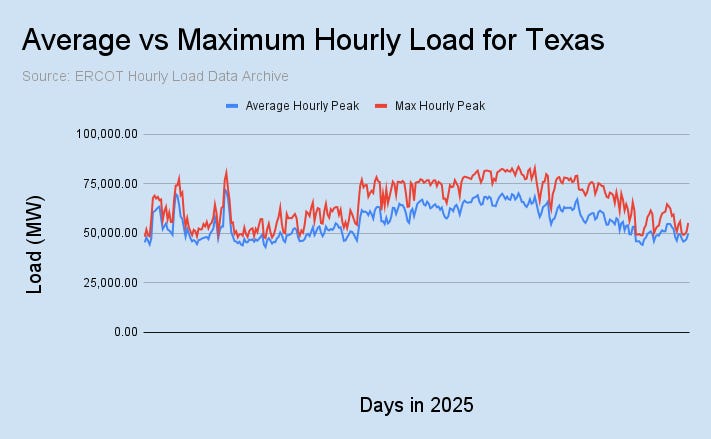
As previously discussed, storage and transmission can both be used on the supply side to shift capacity in time and space, which can help to reduce peaks. Another category of solutions can be used to adjust the demand side, which are collectively referred to as demand response. This can be as simple as a grid operator calling a large power consumer in an emergency and asking them to reduce demand, or as complex as smart grids that can orchestrate demand across millions of devices at once.
Historically, many of the uses for electricity were not well suited to demand response programs. Asking a home or business to turn off lights, or stop using appliances and electric motorized equipment is disruptive and unpopular. However, some of the growing uses for electricity, such as heating and battery charging, are much more amenable to shifting demand without inconveniencing their end users. The air inside a building and the water in a hot water tank are essentially large thermal batteries, and the timing of their connected heat pumps can be adjusted to run a little earlier or later to better match electricity supply. Similarly, if you plug in your electric car after coming home, you don’t care when it charges as long as it reaches the desired charge in time for the next day.
Pricing Mechanisms
One of the simplest ways to adjust demand is to expose end-users to more of the variation in electricity cost based on time of day. Time-of-use pricing schemes encourage consumers to adjust their flexible loads to periods of excess supply. Since this lowers electricity production costs by shifting from expensive to cheaper power sources, these systems can pass along some of the savings to end-users as an incentive. As mentioned in my BESS post, some jurisdictions are even introducing periods of free electricity, which creates a strong incentive to use that time to charge a car or run appliances. My home province of Ontario has a choice of three different electricity rate plans, including a basic time-of-use price based on peak demand, and an “ultra-low overnight” plan targeted at owners of residential or EV batteries. Since Ontario electricity generation is largely nuclear and hydro plants which are difficult to shut off, overnight electricity is very cheap since it will be produced anyway. In regions with a high degree of solar power, the opposite happens where electricity becomes nearly free to produce in the middle of the day. Time-of-use pricing has also been widely deployed in many European countries, Japan, and California.
A major limitation of price-based demand response is that it is a very blunt instrument. Prices are typically set over a wide customer base, and are updated infrequently. This can result in new peaks forming when consumers shift their demand to the newly cheap periods. Particularly with renewable energy sources, supply varies based on factors other than time of day, such as temperature and weather patterns, which are too complex to build into a pricing scheme.
Another financial mechanism for demand response are voluntary incentive programs. In these programs, participants are either paid or given an incentive to join a system where they commit to reducing consumption or increasing supply at specific periods. These systems are sometimes designed for emergencies, such as the Emergency Load Reduction Program (ELRP) in California. Others, such as the Block Exchange Notification of Demand Response (NEBEF) program in France, operate throughout the year. In either case, participants are paid based on the electricity they avoided using during peak demand periods.
Technology
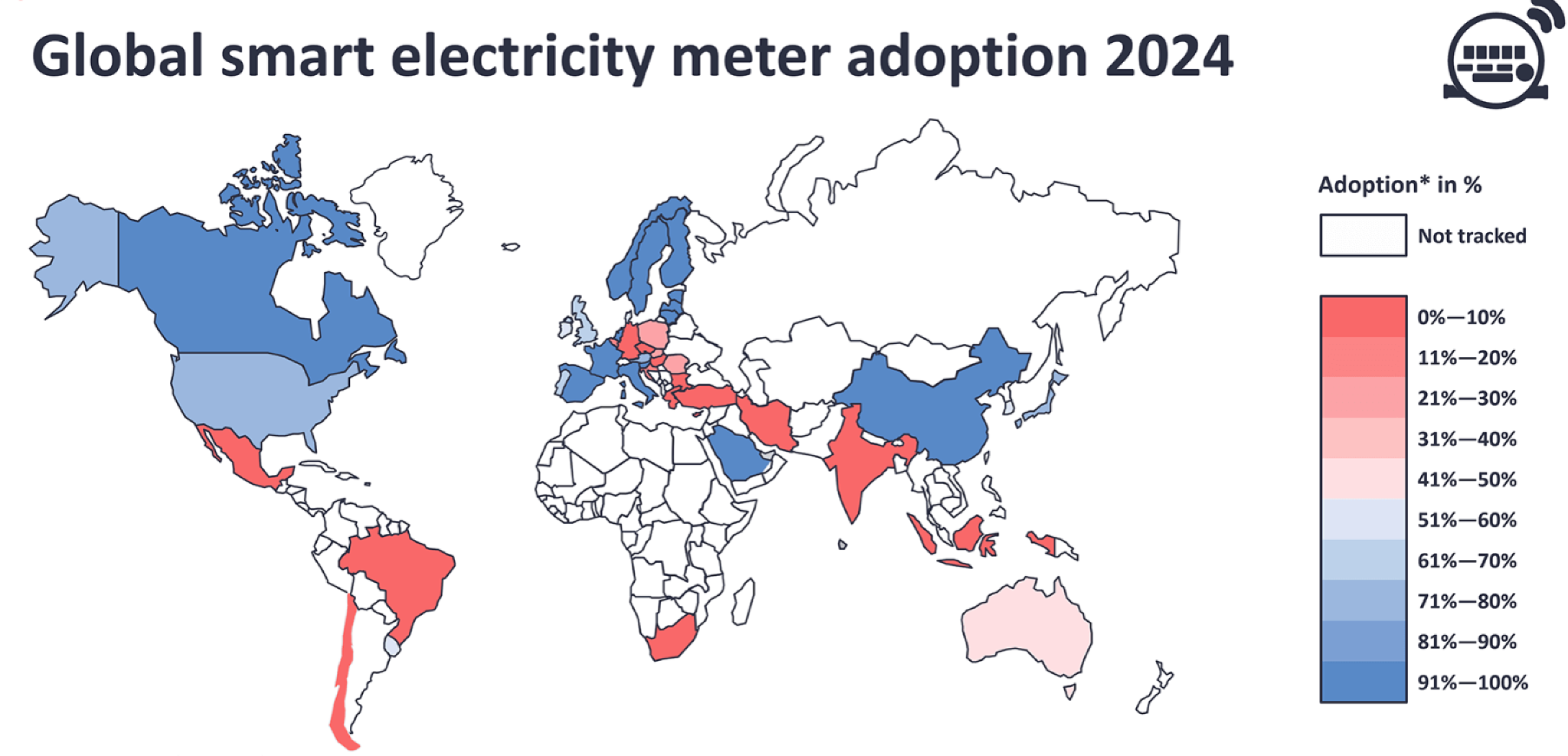
The most basic ingredient for any demand response system is more granular measurement of electricity usage. In much of the world, electricity is sold for a fixed price, and meters may only be read once per billing cycle. This means an electricity provider has no way to check whether a consumer shifted their demand. While demand response programs are still possible in such a system, they would be voluntary and unreliable. Smart meters with two-way communication back to the electric utility are therefore an important first step towards more sophisticated approaches. There are widely adopted standards for meter communication protocols, including IEC 62056 and ANSI C12 in the US. Communication can happen either over cellular connection, powerline communication, or through a radio frequency mesh network. Smart meters have been widely adopted in recent years, with 1.8 billion installed as of 2024 (Counterpoint Research).
The following chart by IOT Analytics shows a regional breakdown of smart meter adoption (source).
With measurement in place, the next level of technology is to automate demand response. This involves having a device connected to an energy-consuming device or appliance that can receive requests to shift demand. A common example is a smart thermostat that can adjust the thermostat based on external signals. In a large network of such devices, they can each be given different staggered times to reduce power, creating a smoothing effect over the wider electricity network. Open protocols and standards are heavily used in this space, due to the need to coordinate devices across a variety of vendors. Here are a few of the key technologies that are heavily adopted:
MQTT: A protocol for IoT communication, a popular message passing layer for smart devices. While it doesn’t implement demand response features directly, it is used as a base layer by higher order protocols.
OpenADR: A demand response software protocol using MQTT. Originated in California but now widely deployed around the world.
Smart Energy Profile (IEEE 2030.5). While not specifically designed for demand response, this is a more general profile for communication between utilities and consumer devices such as thermostats, inverters, and appliances that is used in many demand response programs.
CTA-2045: Standard for a hardware socket on appliances, enabling them to be connected to, and controlled by, a network.
This is an area where machine learning has begun to play a useful role in the electricity system. Fundamentally this is a large constraint satisfaction problem, where you want to achieve certain outcomes (building temperature within a given range, a battery charged by a given time), while minimizing cost by matching demand as closely as possible to the generation supply curve. Meanwhile, demand behaviour is never consistent, and some loads are heavily influenced by weather patterns. There are several open source ML algorithms that have shown strong results in smoothing aggregate demand, including XGBoost, and Random Forest (Scientific Reports).
Demand Aggregation
Shifting the electricity consumption of a single device on the grid is not particularly useful. To influence aggregate demand, thousands or even millions of devices need to be connected to a common demand response network. Devices participating in such a network are called distributed energy resources (DER), and can include both loads consuming electricity, as well as distributed sources of supply such as solar panels and batteries. A network of DERs producing electricity can go a step further and act as a virtual power plant (VPP). The idea behind VPPs is that from a grid perspective they can behave exactly the same as a traditional power plant, ramping supply up and down based on bids or signals from the grid operator. There are several successful VPPs operating today that can contribute power to the grid at GW scale, including Kraken (UK), OhmConnect (California), and South Australia VPP. These networks can reduce or eliminate the need for gas peaker plants, resulting in significant cost savings for energy consumers.
A key question in this area is who should fill the role of demand aggregator. As you might expect, demand aggregation is a Silicon Valley specialty and there are a variety of startups looking to fill this role and extract some of the cost savings in profit. The more obvious option in the long term is that the utilities who already have a connection with end-users introduce DR programs along with appropriate incentives. A third path is for software vendors to supply the tools, and then leave utilities to operate them and own the connection to customers. These software platforms are called distributed energy resource management systems (DERMS). Some of the top vendors in this space are Eaton, GE Verona, EnergyHub, and Kraken.
Summing up
Strictly speaking, demand response is not an essential part of the transition to renewable energy. However, the alternative is to build infrastructure that can handle peak demand at all times, which is a far more expensive path to take. Since electricity cost is so important to modern economies, having some mechanism to shift demand and reduce the need for additional generating capacity and grid infrastructure is an obvious step to take. If batteries continue to get cheaper, they may reduce the value in having this grid intelligence filter down to every device and thermostat though. Both grid-scale BESS and whole-home batteries act as buffers to absorb variability, which should result in a smoother and more efficient grid overall.
Resources
PG&E Load Management Programs - High level overview of the demand response program in California
Industrial Conservation Initiative - Example of a commercial/industrial demand response program in Ontario.
Smart Meter Adoption - Detailed report on global smart meter adoption
OpenADR 3.0 - Spec for an open source demand response protocol (email required for download)
IEA Demand Response - Overview of the topic from the IEA, including lots of stats and references to real world examples
The Case for VPPs - Presents the economic case in favour of VPP programs