
HVDC Transmission
Why transmission is important
As discussed in last week’s post on battery storage, electric grids must precisely match electricity supply and demand at all times. Since electricity demand varies throughout the day, and the cheapest sources of electricity generation are also variable, there is a significant need to be able to shift electricity supply to better match with demand. While batteries accomplish this by shifting supply over time, long distance transmission accomplishes the same thing by shifting supply in another dimension: space.
Connecting grids from east-west lengthens the effective daytime for solar power, and helps smooth out the net demand curve across the area. Connecting grids from north-south accomplishes a similar effect for wind power, since the latitude of prevailing winds shifts across seasons. More generally, different geographic regions tend to have a different mix of power sources, creating opportunities for arbitrage across regions depending on local electricity demand and weather conditions.
A very effective combination is to connect a region with large sources of variable power (wind and solar), to a region with significant hydro power. While the variable power is generating, hydro dams can lower their flow and build up their reservoirs, acting like a giant battery. When the variable power drops, the hydro dams can open the taps and the flow of power between regions reverses. There are several major examples of this in practice today, including Norway hydro connecting to wind-producing regions of UK and Denmark, and hydro in the Pacific Northwest in North America connecting to solar-producing California.
In the following electricity generation graph from California, the red and orange bars represent imports and exports. We can see net imports overnight, and net exports during the day (from excess solar power).
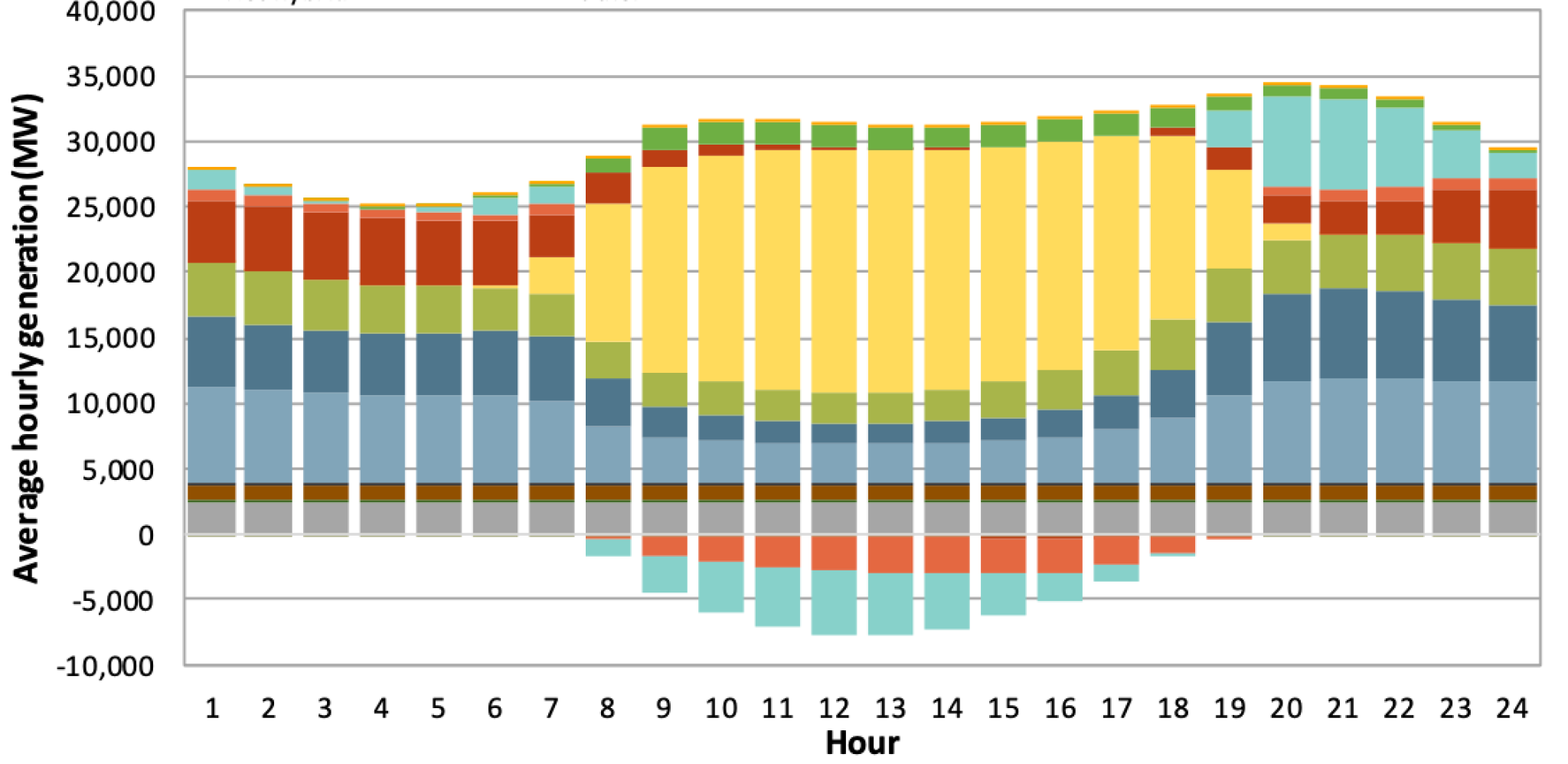
Source: CAISO Q2 2025 Market Report, p. 17
If we look at the comparable graph for the Pacific Northwest ISO, which largely produces hydro power, we see the inverse pattern of exports overnight and imports during the day
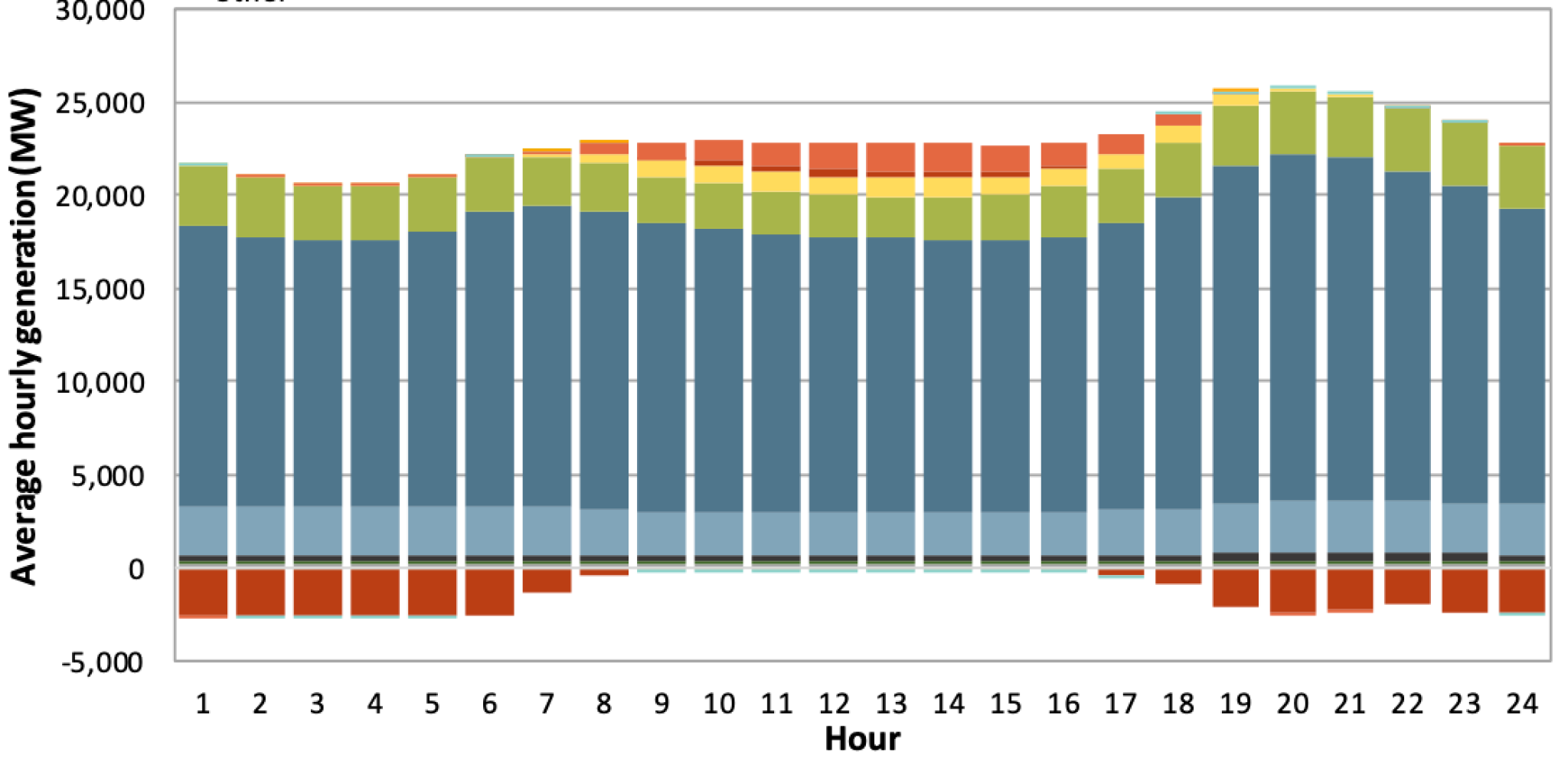
Source: CAISO Q2 2025 Market Report, p. 19
The effect in this case is relatively small since the interchange capacity between these regions is limited, but it results in lower power prices overall in both regions. Similar transmission lines in Europe, such as ElecLink between UK-France and the North Sea link between UK-Norway are highly profitable for grid operators, reduce price fluctuations, and avoid the need to curtail excess renewable power.
Technical details
Long distance transmission lines have two key technical differences from regional transmission lines: Higher voltage, and often use of DC current instead of AC. The reasons for each of these are worth exploring, so we’ll look at voltage first.
The electricity formulas you learned in high school science help to explain why higher voltage is important. In short, power transmitted (P) in a circuit is the square of the voltage (V) divided by resistance (R). This means that as voltage increases (with correspondingly lower current), the total power transmitted increases quadratically. This makes a significant difference when transmitting power over long distances. The lines running through a residential neighbourhood are typically 10-30 kV, and the line to your house is typically 0.25 kV. Long distance transmission lines are usually between 500-800 kV, and newer ultra-high voltage (UHV) lines can be as high as 1,100 kV.
The reason for using DC power rather than AC is a little more complex. In short, AC power suffers from multiple kinds of energy losses during transmission that are not seen with DC (this video is a good explainer on the details). While the exact losses depend on the particular cables used, on average AC lines lose about 6.7% of their electricity for each 1000km transmitted, vs 3% loss for DC lines (source). Again, when transmitting large amounts of power over long distances, that difference in loss rate has a significant impact.
AC transmission also relies on air gaps between wires as both electric insulation between phases and to dissipate heat. When creating transmission lines that run under either land or water, AC suffers from far higher transmission losses, making them impractical for any sub-sea or subterranean wires over about 50km in length. DC lines don’t suffer from the same capacitance problems as AC, so they are ideal for underground and sub-sea transmission.
If DC is so much better, why isn’t it used all the time? Historically, it was very difficult to change the voltage of DC. The oscillations of AC power can be used to generate a magnetic field, which can in turn be used to induce an electric field in a second coil at a different voltage (this system is called a transformer). Since our grids frequently need to step voltage up and down, this flexibility of AC power is a great asset that generally offsets the transmission losses. Since the 1970’s, converters have been introduced that can change the voltage of DC circuits using transistors. If we were designing a new grid from scratch, DC would possibly win out, but for now we have to integrate with the AC grids we have in place.
Today it is a purely financial choice on whether to use AC or DC for long distance transmission. At each end of a DC line you typically need hardware to convert electricity to/from AC to integrate with the local grid, which is expensive. At sufficient throughput and distance, the transmission efficiency of DC outweighs the infrastructure cost of conversion. If one end of a long distance line consists entirely of DC power generation, such as wind, solar and batteries, then DC transmission is a more obvious choice. As previously mentioned, DC is also the obvious choice for any sub-sea transmission. I have seen wildly varying quotes on the break-even distance when DC becomes more economical, with more recent reports showing much lower distances than 5+ years ago. The most detailed and up to date analysis I’ve found is that DC is more effective starting at 150-275km depending on voltage (source, p. 175).
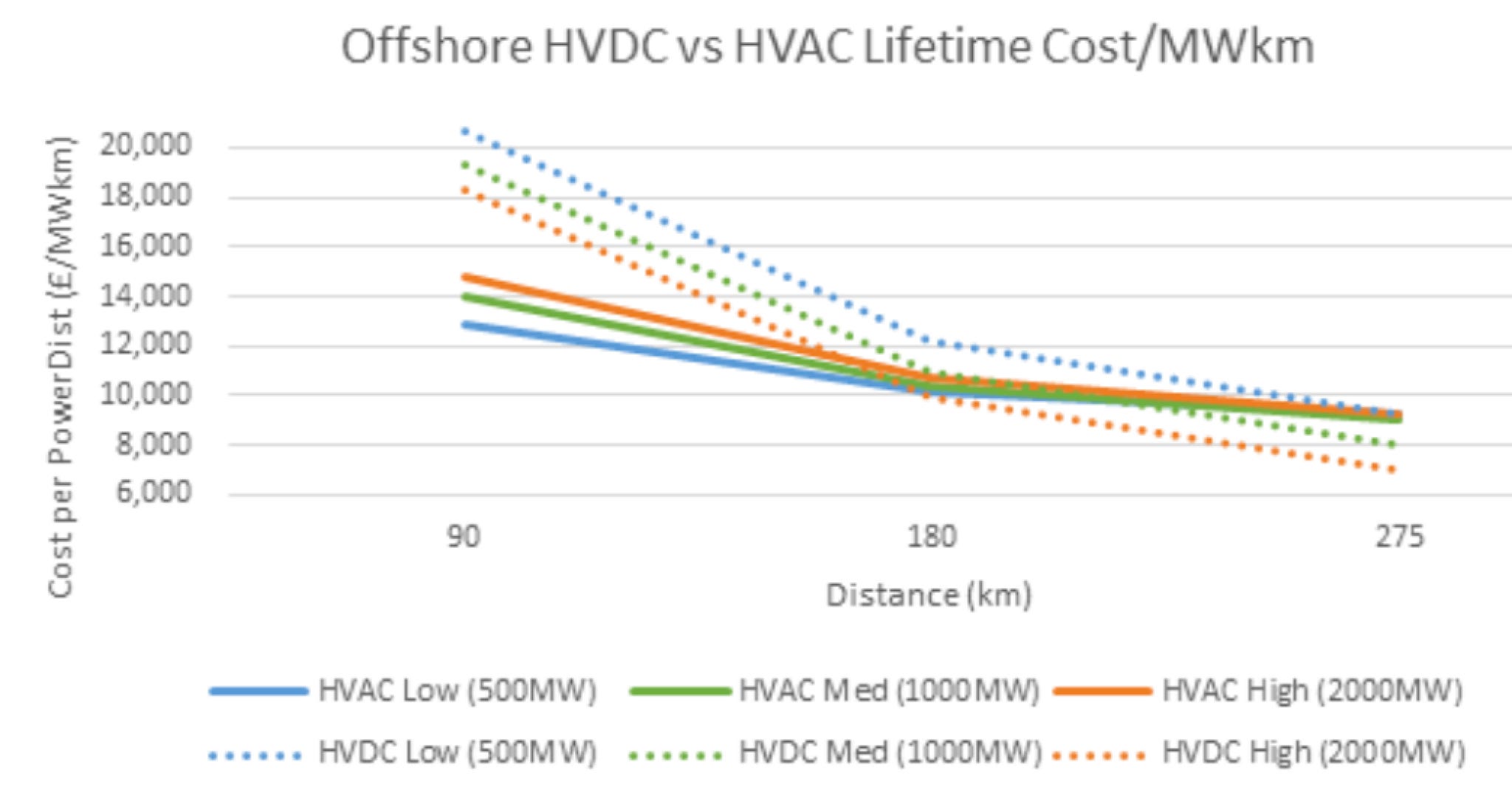
Source: Mott Macdonald, p. 119
I can’t resist a brief mention of a fun niche area: super-conducting transmission lines. High temperature superconductors (HTS) are about the closest thing to magic in the natural world. In these materials, electric resistance drops to zero at a particular temperature threshold (around -180℃), allowing electricity to be transferred with absolutely no losses. The downside is the wire needs to be cooled and insulated to quite a low temperature, but in some applications the energy required for cooling is made up by the lack of line loss during transmission. Overall these lines require far less space, since they don’t need air gaps as insulation (no resistance means no waste heat). Today these lines are only used in niche applications over short distances, but there are a few companies exploring their use in long distance transmission as well (notably Nexans in Germany).
Politics
Unfortunately, the main challenges for long distance transmission are rarely technical. Frequently, the biggest hurdle is getting the governments on each side of the transmission line to agree to make the connection, who pays for it, how it is regulated, who profits, etc. Most countries, or even regions within countries, are reluctant to become too reliant on interconnections with other jurisdictions for their power needs. For consumers, the side with the most expensive electricity stands to gain the most, by importing cheaper electricity. This makes building them less politically acceptable in regions with low cost electricity. For expensive producers, new interconnections can reduce their pricing power and profits, which can lead to lobbying against them. The high upfront cost of new transmission lines is also a major barrier, and it is often more appealing to invest in new generation than in transmission.
Compared to other regions, Europe has been more successful in building international connections. China has also been successful in building long distance transmission between their cities in the east and solar-wind producing desert regions in the west of the country. They have built dozens of ultra-high voltage lines in the past decade, using a mix of AC and DC lines, and with lengths up to 3,200km. North America is a major laggard in building new transmission capacity, where buildout has been falling steadily since 2013 (source). Even between individual states of the US, or provinces of Canada, agreement on building new interconnections seems to take many years. However, as the proportion of renewable generation increases on a grid, the value of interconnections rises dramatically, so we should expect to see the pace of building new long distance connections increase in the coming years.
Resources
HVAC Transmission Explained - a detailed technical overview of HVDC lines, and how they differ from AC.
A Comparison of Electricity Transmission Technologies - a detailed recent (April 2025) analysis by the Institute of Engineering Technologies, focusing on costs of different transmission technologies. There is a lot of very stale information online so this is a valuable source of fresh data.
The electric power grid - a high level overview the North American electric grid