
Battery Energy Storage Systems
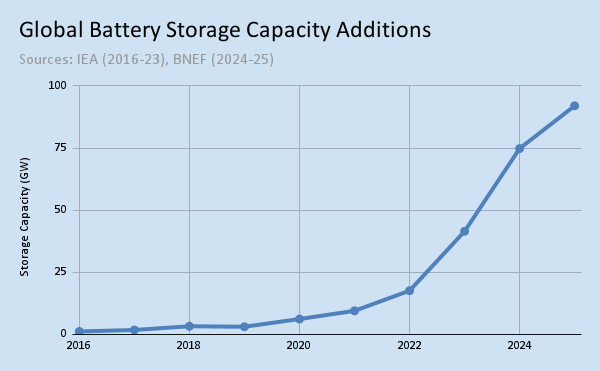
While I already wrote last week about lithium-ion batteries, one of the emerging battery applications is so important to the energy transition that it’s worth a deeper dive: Grid-scale battery energy storage systems (BESS). This is a technology undergoing rapid deployment at an impressive scale, with an expected 92 GW of capacity added in 2025 (BNEF).
The importance of storage
Utility grids face an absurdly difficult requirement that they must precisely match supply and demand for electricity at each minute of the day. Too much or too little power at any moment can cause grid instability or outages. This is a problem for both conventional and renewable power generation, since with the exception of hydro it is difficult to rapidly ramp generation up or down efficiently. Demand varies based on time of day, season of the year, and weather conditions. As you might expect, demand ramps up quickly starting around 6am, often dips slightly in the middle of the day, and ramps to a daily peak between 4-8pm. As an illustration, here is the system demand for California’s grid (CAISO) on November 5, 2025.
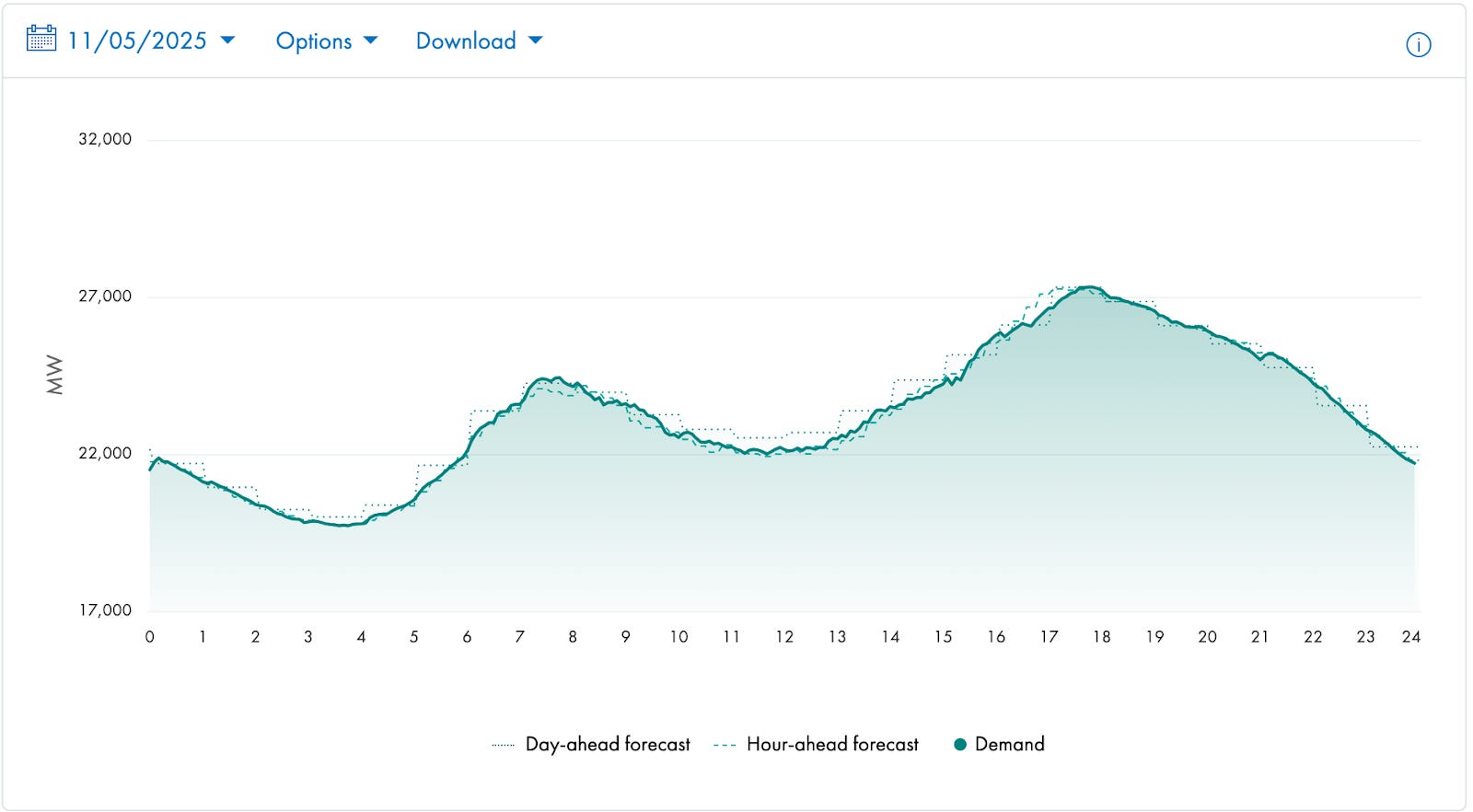
Source: CAISO demand outlook
On top of this varying demand come renewable power sources, which each have their own patterns of availability. Solar and wind power have both daily and seasonal variance, and to a lesser extent hydro power as well. Without storage, renewable generation often produces too much or too little power to match demand. Even base load generators such as nuclear plants usually produce excess power overnight.
This variation in supply and demand results in wild daily swings in the spot price of electricity. While end consumers are typically shielded from these swings, it averages out to higher prices on utility bills. As I write this on a typical day in November, the marginal price of electricity in Ontario has varied between $35/MWh to $400/MWh depending on location and time of day. Some regions have capacity markets, where a supplier is paid to have power available that may never be needed, which layers on further costs.
The obvious response to this variation in most markets would be to buy power when it’s cheap, and sell it when it’s expensive. Until recently though, storing electricity on a scale required by power grids was very difficult. The most common method was pumped hydro storage: using excess power to pump water into a higher reservoir, and then run it through a turbine to produce power later. This works fairly well, with only about 25% of the energy lost in the round trip for a typical installation. Unfortunately pumped hydro systems are expensive to build, and require a particular geography that is not always available (generally a series of lakes in a mountainous area).
This is where battery storage enters the picture. While batteries cannot economically solve the problem of seasonal supply/demand variation, they have proven very capable of solving for intra-day variation. The mid-market price for a grid-scale BESS in North America is $334 for each kWh of battery capacity. Assuming the peak electricity price in a 24-hour period is $0.10/kWh higher than the lowest price, a battery charging at the low price and dispatching at the high price, with 85% round-trip efficiency, could earn $0.085/kWh per cycle. Assuming an LFP battery can run through 4,000 cycles before replacement, it could “earn” $340 for each kWh of capacity during its lifetime. In practice, the price spread can run much higher. Converting the Ontario marginal prices mentioned earlier, $35/MWh = $0.035/kWh and $400/MWh = $0.40/kWh, revealing a spread of $0.36/kWh. These are very crude calculations that gloss over many details, but illustrate the point that battery storage systems can dramatically lower costs, particularly by avoiding curtailment of renewable power sources with zero marginal cost.
Coming back to California’s daily supply and demand, we can see the effect of grid-scale batteries in action:
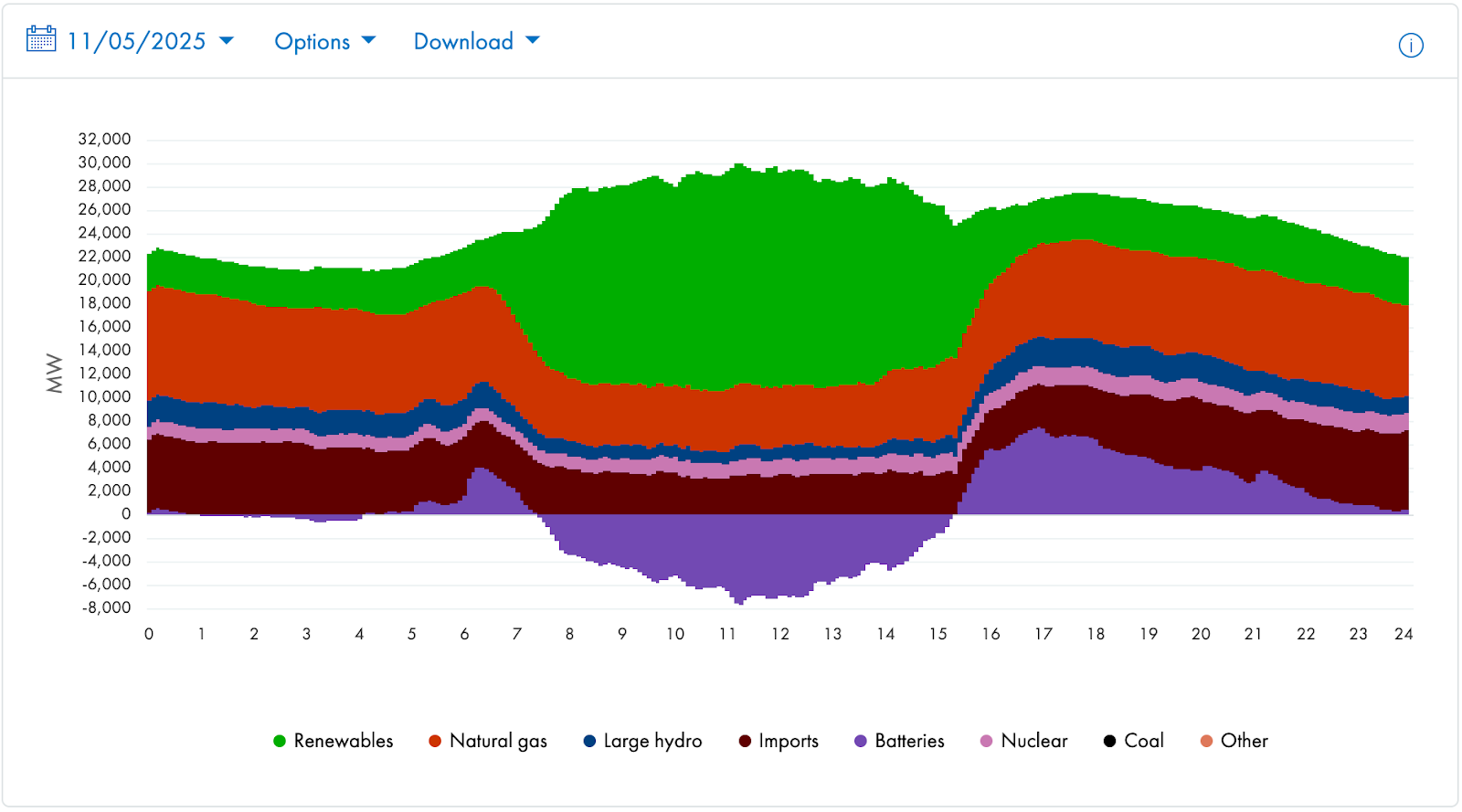
Source: CAISO supply outlook
Here you can see how renewables (green) and batteries (purple) work together to meet demand throughout the day. Batteries handle the initial ramp up in daily demand before the sun rises. Once solar ramps up, supply exceeds demand, with the excess sent to charge the batteries. Demand is peaking at this time of year just as the sun sets, but batteries can be deployed to meet this demand through the evening period. Batteries can often charge further during the night, when baseload generators such as nuclear stations produce power that cannot be switched off. California is now regularly setting records for the peak rate of battery charging (currently 9,647 MW) and deployment (11,166 MW) as more capacity is deployed.
Ancillary Services
Price arbitrage is only one of the grid services that can be supplied with batteries. Their software/hardware stack also enables them to play a role in regulating AC frequency in the grid, which can become unstable when too many intermittent sources are connected. The Waratah Super Battery in Australia, currently the world’s largest BESS by capacity (850 MW / 1680 MWh), is designed mainly to buffer against instability and supply shocks. For example it can carry much of the grid’s demand while swapping between major power sources, such as when a large power plant or transmission line connects or disconnects. In this way, a BESS can reduce the amount of redundant capacity the grid needs to have online to handle unexpected supply or demand shocks.
A final important use case for BESS is to defer or avoid expensive transmission infrastructure upgrades as demand for electricity increases. A simple example of this can be seen in a typical household. In the US, the average house consumes 30kWh of electricity per day. This demand could, in theory, be satisfied with a dedicated 1.44 kW (6A, 240V) electrical service paired with a battery to distribute the load over time. In practice, a typical household has a 48 kW service (200A, 240V), which means its “transmission infrastructure” is at least 30x overbuilt. In practice the cost of wiring 6A versus 200A in a residential context is not significant, but when you apply the same logic at grid scale, battery storage can eliminate the need for highly expensive upgrades to long distance transmission lines. This is why BESS installations are often co-located with a very large power producer or consumer, or even near a decommissioned conventional power plant, so they can maximize utilization of existing transmission infrastructure.
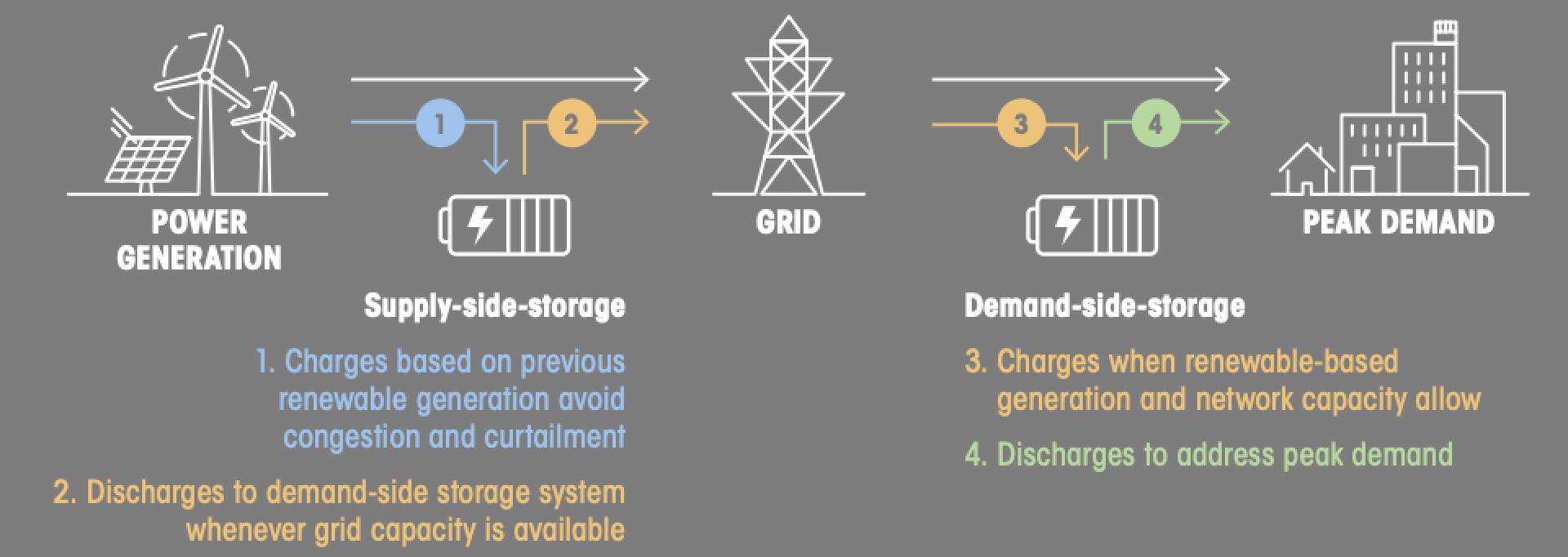
Source: Virtual Power Lines, p. 3. IRENA
So far we’ve focused on BESS that are deployed directly by utilities or grid operators, which are called “Front of the Meter” (FTM) systems. BESS can also be deployed by individual homes and commercial operations, so called “Behind the Meter (BTM) systems. These can be used by electricity consumers both to “time shift” their electricity consumption based on pricing, and as a form of backup power. Some utilities are incentivizing BTM deployment by offering very cheap electricity for certain periods, which can be used to charge batteries. Octopus Energy in the UK, and some parts of Australia, are even beginning to offer free electricity at times of day when renewable supply is plentiful. Residential BESS are typically twice as expensive per kWh than utility-scale FTM systems due to their high installation costs, but can still pay for themselves through rate savings over the system lifetime. For a deeper look at costs, Lazard’s annual Levelized Cost of Energy report includes a detailed analysis of the cost of both FTM and BTM battery storage systems (which they call Levelized Cost of Storage - LCOS).
Overall, adding BESS to the grid as renewable generation increases helps to make grids more resilient, cost efficient, and flexible. Steady improvements in batteries, both increasing durability and falling prices, are feeding a virtuous circle of adoption. Batteries are particularly well suited to pairing with solar, since a hybrid solar+battery plant can provide power over 24 hours. It is now becoming the norm to pair these together, both in front of and behind the meter (see for example Berkeley Lab, Australian Clean Energy Regulator).
A final note of caution on battery hype: While batteries are the best available solution for intra-day variation, they are not well suited to periods beyond a day or two. As the storage duration increases, the cost of batteries scales poorly because cost is proportional to capacity. In some geographies, other forms of storage will be needed to store energy over weeks or seasons. There does not appear to be a clear winning technology for long term energy storage yet.
Resources
The BESS Book, by Drew Lebowitz, Sean Daly, and Swetha Sundaram. This book covers everything you need to know to build grid-scale energy storage, covering engineering, finance, regulation, etc.
Stanford Energy Storage Lecture, by Adrian Yao. This lecture focuses on batteries, but provides a good overview of energy storage systems and markets as well.
Effective Load Carrying Capacity of Energy Storage. This technical paper is a nerdy level of detail and focused on a particular market (Ontario), but I found it a fascinating analysis of how the supply/demand dynamics of a system evolve over time as renewable and storage are added.
IEA Grid Storage - A good high level overview, but note that it is two years out of date at the time I’m posting this.
Solid overview of BESS economics. The transmission deferral point is underrated because it flips the whole cost-benefit calc for storage. Instead of only earning arbitrage spread, BESS can basically unlock stranded generation capacity that would otherwise require multi-billion dollar grid upgrades. Once you factor in avoided capex on transmisson lines, the payback period shrinks way faster than most modls assume.