
Lithium-ion Batteries
Storing electricity in the form of chemical potential in batteries has emerged as a major pillar of the energy transition in the past few years. In 2024, over 1.1 TWh of batteries were produced, a growth of 10x since 2018 (BNEF Electric Vehicle Outlook 2025). Prices are rapidly falling as production scales up, opening the door to new applications. Global battery manufacturing capacity is far higher than actual production, but has struggled to reach full utilization due to supply chain challenges.
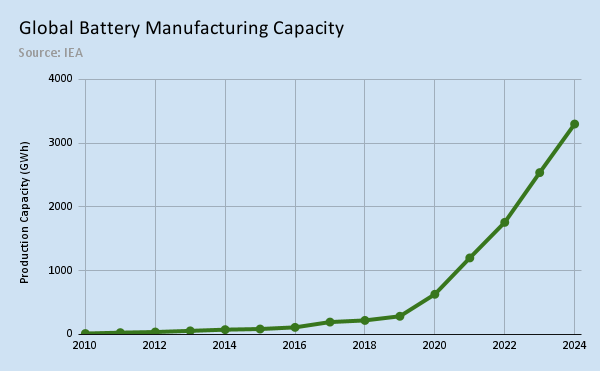
This is a mind boggling scale of battery production. To put this in context, the world produced 93 million motor vehicles in 2024. 3,300 GWh is enough to supply half of them with the typical 70 kWh battery found in electric cars. Or to put it another way, this is enough capacity to store 5% of the world’s daily electricity use. While 85% of manufacturing capacity is currently in China, many other countries are ramping up production to reduce supply chain risks.
The first major use case for batteries in the energy transition was as a portable energy store for electric vehicles. However, as the cost of batteries fell, they have begun to play a major role in electricity storage for the grid. Electricity demand varies throughout the day, and some of the key renewable energy sources are also intermittent. Battery Energy Storage Systems (BESS) play a key role in storing electricity when it is not needed, and providing it back to the grid when demand exceeds supply. Roughly 75% of Li-ion battery production today is for EVs, 15% for BESS, and 10% for other uses such as consumer electronics (treat these as rough figures because I’m using a mixture of data from BNEF and IEA). Both electric vehicles and BESS are deep topics in their own right, so I will cover the specifics of these in separate articles. For now, I will focus on the fundamental characteristics of batteries and the factors that have made them so attractive.
Here are a few key terms that are important to understand when reading about batteries:
Power rating - Maximum rate at which power can be dispatched, in kW or MW
Energy rating - Total amount of energy stored, in kWh or MWh. Sometimes also referred to as capacity.
Duration - The time it takes to discharge the battery at maximum power rating. For example a 4 MWh battery with a power rating of 1 MW has a duration of 4 hours. Lithium-ion batteries typically have a duration of 1-4 hours, although in many applications the battery is not discharging at its maximum power rating. These durations are optimized for current dominant use cases, such as EVs and load-shifting in markets such as California. There is no reason a battery couldn’t have a longer duration such as 8 or 12 hours, although this will increase the price, which tends to be proportional to energy rating rather than power rating.
C-rate - Reciprocal of the duration in hours. The previously mentioned 1 MW / 4 MWh battery has C-rate=0.25C
Nominal voltage - A battery’s voltage drops as the battery is discharged, so there is no single voltage. The nominal voltage is an approximation of the average voltage output by the battery. Technically, it represents the average voltage between 75-25% charge. Voltage drops significantly from 100-75% charge, then stabilizes, before dropping significantly again when below 25% charge.
Round trip efficiency - Energy out as percent of energy put in. Li-ion batteries have RTE of 80-90%
Battery Chemistry
The single battery technology that has emerged as a highly scalable winner is the lithium-ion battery. In these batteries, a chemical reaction splits lithium into a positively charged lithium ion (Li+) and a free electron, producing an electric current. An inverse reaction pairs Li+ with an electron to store electricity as electrochemical potential. While these batteries all use mainly graphite (carbon) on their negative electrode, a variety of different compounds have been used for the positive electrode. When you hear about a specific battery chemistry, it generally refers to the key elements on the positive electrode. The two chemistries with highest adoption today are lithium nickel manganese cobalt (NMC) and lithium iron phosphate (LFP or sometimes expanded as LiFePO4).
NMC was the incumbent chemistry, leading global battery production until 2022. Compared to LFP, it has a higher energy density, making it better suited for EVs in particular. However, LFP batteries have three key advantages over NMC:
They do not use cobalt, which is a key cost and supply chain risk for NMC. This also makes LFP less expensive to build (about 20% cheaper).
They can handle more lifetime charge cycles than NMC (around ~4000 compared to ~2000 for NMC). This makes the lifetime cost even lower when amortized over twice as many cycles.
They are safer, due to a higher thermal runaway temperature (270℃ for LFP vs 210℃ for NMC). This is the temperature at which a battery system burns uncontrollably, which has led to some major fires at early NMC BESS plants (BESS Book, p 56-57).
These factors have led to LFP becoming the dominant chemistry by a significant margin for both EVs and BESS, with NMC still leading for small consumer electronics where weight is the major factor. The battery industry is now at a very large scale, and plants can take years to plan and build, so LFP is expected to be the #1 choice for at least another 5 years.
The level of innovation on specific battery chemistries has made the battery industry quite dynamic and adaptable. Cobalt became difficult to source as adoption increased, which led to the rise of LFP as an alternative. When lithium itself became very expensive in 2022, sodium-ion batteries were developed as an alternative. While LFP batteries will be the dominant choice in the near future, there is a strong pipeline of contenders for future battery technologies that could unlock further gains, both in alternative chemistries, and in entirely different designs such as solid-state and flow batteries.
Economics
The reasons lithium-ion batteries have emerged as a key leader of the energy transition are improvements in energy density (watts per litre or kg) and cost ($/kWh). In the past ten years, energy density has roughly doubled, while cost has fallen nearly 8-fold (Global Electricity Review 2025, Ember). These have largely been incremental efficiency gains due to the vast scale up in manufacturing, although the switch to LFP also contributed significantly to lower average costs.
Discussion of battery costs can be misleading because it depends on what is included - you will see wildly different prices mentioned depending on what is being measured. The simplest measure of costs is the factory price for individual battery cells, which today has a global average price around US$75/kWh (Benchmark Mineral Intelligence). At the other end of the price spectrum, you will see quoted prices for entire battery storage systems. This includes not only the battery cells and packs, but the inverter, enclosure, installation costs, taxes, profit, etc. A useful middle ground is to look at the price of battery packs, which contain several cells wired in series to obtain the desired output voltage, in a durable enclosure. No matter which price you look at, they have been falling steadily for the past decade, apart from a brief rise in 2022 due to lithium supply chain problems.
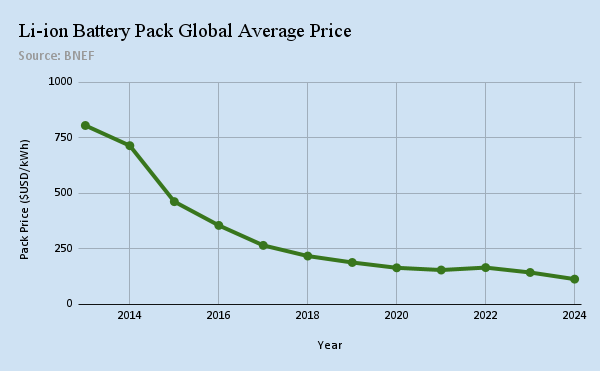
(Source: BNEF)
Battery costs are the main driver of EV costs, so this cost reduction has finally made EVs competitive with legacy ICE (internal combustion engine) vehicles. Particularly in China, EVs are now roughly at cost parity with ICE cars, even ignoring the significantly lower operating costs for EVs (IEA). These cost reductions have also enabled an explosion in grid-scale energy storage, which I’ll dig into further in next week’s article.
Software
A final aspect of batteries worth touching on is that they have a fairly complex stack of surrounding hardware and software that mediates between the “dumb” chemical reactions occurring in their cells, and the external application they are supplying power for. This stack plays a key role in smoothing and shaping the flow of energy coming from the battery, as well as optimizing the battery’s lifetime. There are three main systems involved in both EV and BESS battery applications:
The Battery Management System (BMS). Collects raw data about the battery health and state, balances the voltage across cells in a module, and has mechanisms to protect against unsafe conditions such as under-charging, over-charging, and unsafe temperatures. Keep in mind that the voltage of a single cell changes constantly as the battery discharges, but the aggregate system typically must maintain a constant output voltage, which requires constant balancing.
The Power Conversion System (PCS). Converts between the DC power of battery cells and AC power of the external grid or system, steps voltage up or down, and regulates the frequency of AC power. This system is sometimes simply called an inverter, but technically an inverter only converts DC to AC power, while a rectifier converts from AC to DC power. The PCS typically includes both an inverter and rectifier, along with transformers and transistors to regulate the electric current.
The Energy Management System (PMS). Aggregates data across the BMS of each module in the system, responding to external commands to charge or provide energy, and sends commands to control the PCS based on those external inputs.
These software/hardware systems are an area of significant innovation, with both startups providing novel solutions and battery cell manufacturers moving up the stack to provide some of these systems. This is contributing to steady improvement in the efficiency and lifetime and battery systems, even without changes to the chemistry of their underlying cells. These systems often require adapting to the unique requirements of a given application, such as being able to input DC power for solar charging, or even output DC directly to a long distance HVDC transmission line.
Next week, I’ll focus in on battery energy storage systems (BESS) in more detail.
References
The BESS Book, by Drew Lebowitz, Sean Daly, and Swetha Sundaram. This book covers everything you need to know to build grid-scale energy storage, covering engineering, finance, regulation, etc. Some of the later chapters were a little deep into the rabbit hole for me, but the first several chapters give a detailed engineering intro to batteries from the chemistry up to entire systems. The case studies at the end of the book are also quite interesting.
Stanford Energy Storage Lecture, by Adrian Yao. While all of this Stanford lecture series is interesting, this one is notably very good. The speaker does a great job marrying together the technical and economic factors involved in storage, with a major emphasis on Li-ion batteries.
Various BNEF resources, including this summit video which gives a deep dive on battery costs, EV Outlook 2025, and New Energy Outlook.
Benchmark Minerals is a leading battery analysis firm. Most of their material is subscription-only, but they have occasional free summaries and videos here.
IEA tends to focus on specific applications, but their pages on EVs and Grid Storage have good background information and lots of data.