
Wind Power
After solar PV, wind power is the renewable energy resource with the highest growth and strongest fundamentals in its favour. According to the IEA, 139-155 GW of wind generators are scheduled to come online in 2025. While this is far behind the solar power capacity added, it exceeds the growth rate of all other sources of electric generation (IEA Global Energy Review 2025, p.26). Actual electricity generated has been growing faster than capacity, due to efficiency increases over the past decade.
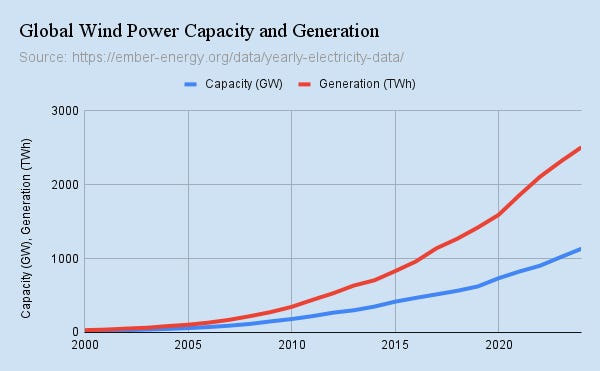
A key factor in favour of wind is that it is a very simple technology. Wind mills have been in use for over a thousand years, and have been used to generate electricity for over a century. They can be built from modular parts, require few advanced components or minerals, and occupy very little dedicated land once built. While the technology is quite mature, they continue to gain efficiency improvements through improved design and materials for their blades, and better modelling of wind behaviour to improve siting of turbines.
The main way wind power has become more efficient is by building ever larger turbines. Wind speeds are stronger and more consistent at higher elevations, making turbines significantly more effective when they are larger. Turbines are now typically over 100m in height on land, and 150m offshore. Blade lengths now average 60m on land, and 100m offshore (U.S. Department of Energy). The main limiting factor on size is the difficulty of transporting larger blades on land, although there are a few startups trying to build massive airships to unlock the ability to install larger blades on land.
As with solar power, the nameplate capacity of a wind turbine is the theoretical maximum energy output at the turbine’s ideal maximum wind speed. Unlike solar, there is no common maximum wind speed used across the industry, and each turbine specifies its own unique maximum rated wind speed. In fact, turbines can be optimized for a variety of wind factors: They also specify a minimum cut-in speed at which they start generating power, and different kinds of turbines are used for locations with highly consistent wind flow vs more turbulent winds. IEC 61400 is an international standard that divides turbines into four major classes (Class I through Class IV), along with subclasses for turbulence levels. Selecting the right turbine for a given site is a key factor in consistent (and profitable) wind energy production.
The capacity factor of a specific wind turbine is calculated from the actual energy output over a period of time, as a percentage of maximum output. The capacity factor for wind tends to be higher than for solar, and has been consistently increasing over time. For example, US wind turbine capacity factors have increased from about 20% in 2002, to nearly 40% since 2016 (Lawrence Berkeley National Lab). By contrast, solar capacity factors tend to be in the 20-30% range. This is because wind produces power over more hours of each day than solar. Many early wind developments are being “repowered” with larger and more efficient turbines to boost their output without needing to invest in new transmission infrastructure.
As with solar, the key challenge for wind power is accounting for its volatility. It is best suited to locations with strong, consistent winds, which are generally found on large plains, mountains, and large bodies of water. The state of Iowa, for example, now generates over 60% of its total electricity from wind alone, thanks to the consistent wind profile of its northern plains. Offshore wind has the highest consistency, although with added expense for both maintenance and getting the power to market.
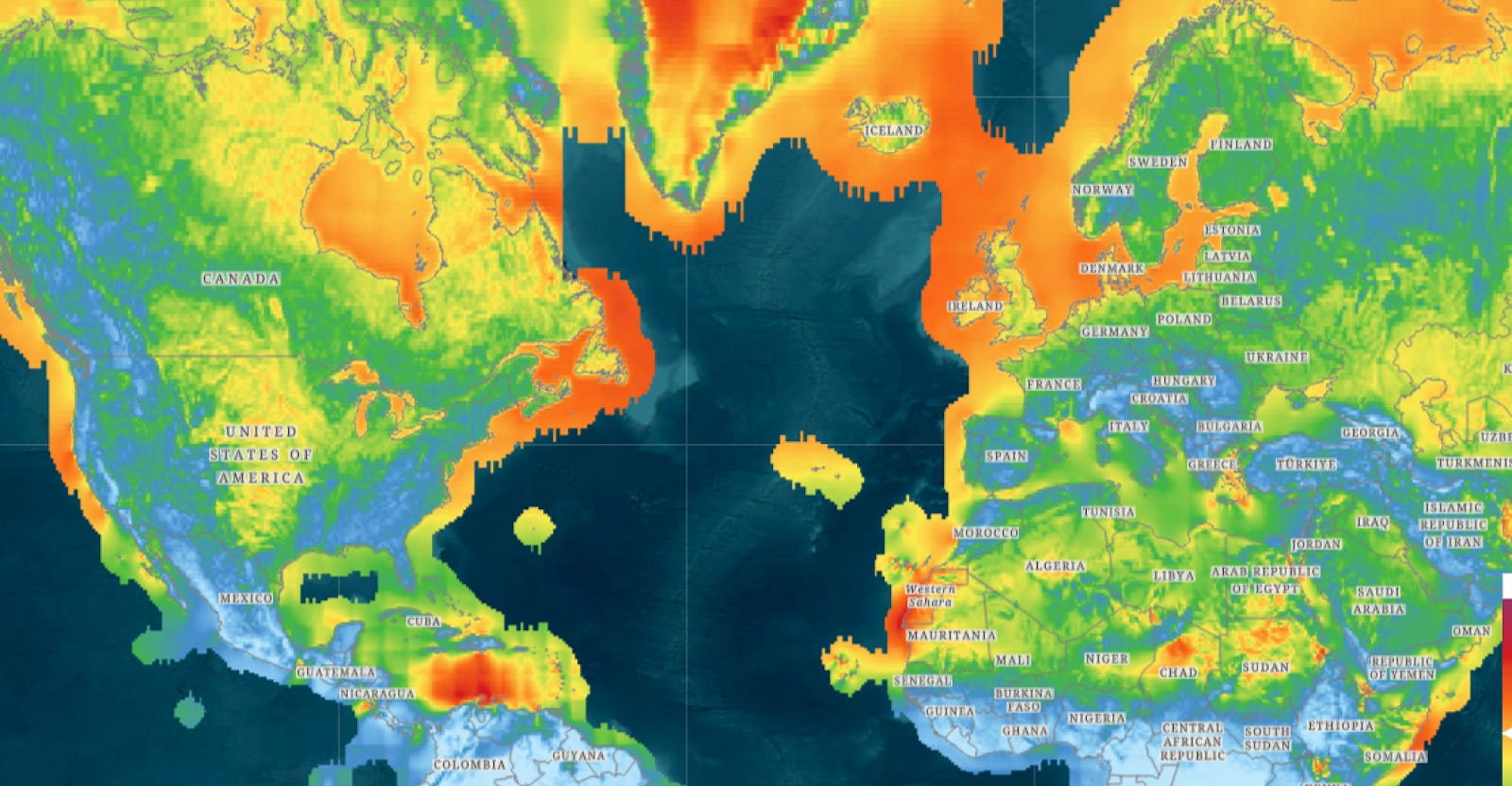
The above image shows the estimated capacity factor of wind generation at different locations. Red means the wind is almost always blowing, and light blue means the wind is rarely blowing. Explore the full data set in the Global Wind Atlas.
Combining wind and solar generation together helps to cancel out some of the volatility of both resources. Wind tends to be stronger at night, during winter, and on cloudy days, which is the opposite of solar. Combining turbines over a larger area also tends to average out to a more consistent net electric output. As with solar power, pairing wind generation with large scale energy storage can also be used to match the supply and demand profiles. One metric used by power grid operators is Effective Load Carrying Capacity (ELCC), which models how an incremental increase of a renewable source compares to “perfect capacity” that is 100% reliable and available. A higher ELCC value means the resource has a better ability to meet the actual grid demand. If there is too much of the same resource in the same location, ELCC values drop because the additional supply may exceed demand at the times it is generating. The optimal mix of wind, solar, hydro and storage varies for a given geographic location
A disadvantage relative to solar is that the best wind resources are located in places far from population centres. While people often live in sunny places, they much more rarely live in windy places such as the central plains of North America, mountain tops, or oceans. Long distance transmission is therefore an important part of the solution, but I’ll dig into transmission technology in a separate post. Inversely, an advantage of wind power is that it requires very little dedicated land once constructed. Rather than outright owning land, wind turbine developers typically lease access to land that can still be used for other purposes. This pairs very well with agriculture, since turbines become an extra source of revenue for farmers with little impact on their farm operations. Large plains are also ideally suited to wind power due to strong consistent winds.
The simplicity of wind power, along with efficiency gains, have led wind power to become very inexpensive. According to Lazard’s Levelized Cost of Energy, onshore wind has been the least expensive source of electricity since 2011, although solar has rapidly caught up. In the past two years the cost of wind power has gone up due to problems with supply chains and grid interconnection, but it is still well below the cost of both nuclear and fossil fuel power plants. Offshore wind is roughly twice as expensive, although this is still worthwhile in many countries because it produces more consistent power and doesn’t use valuable land.
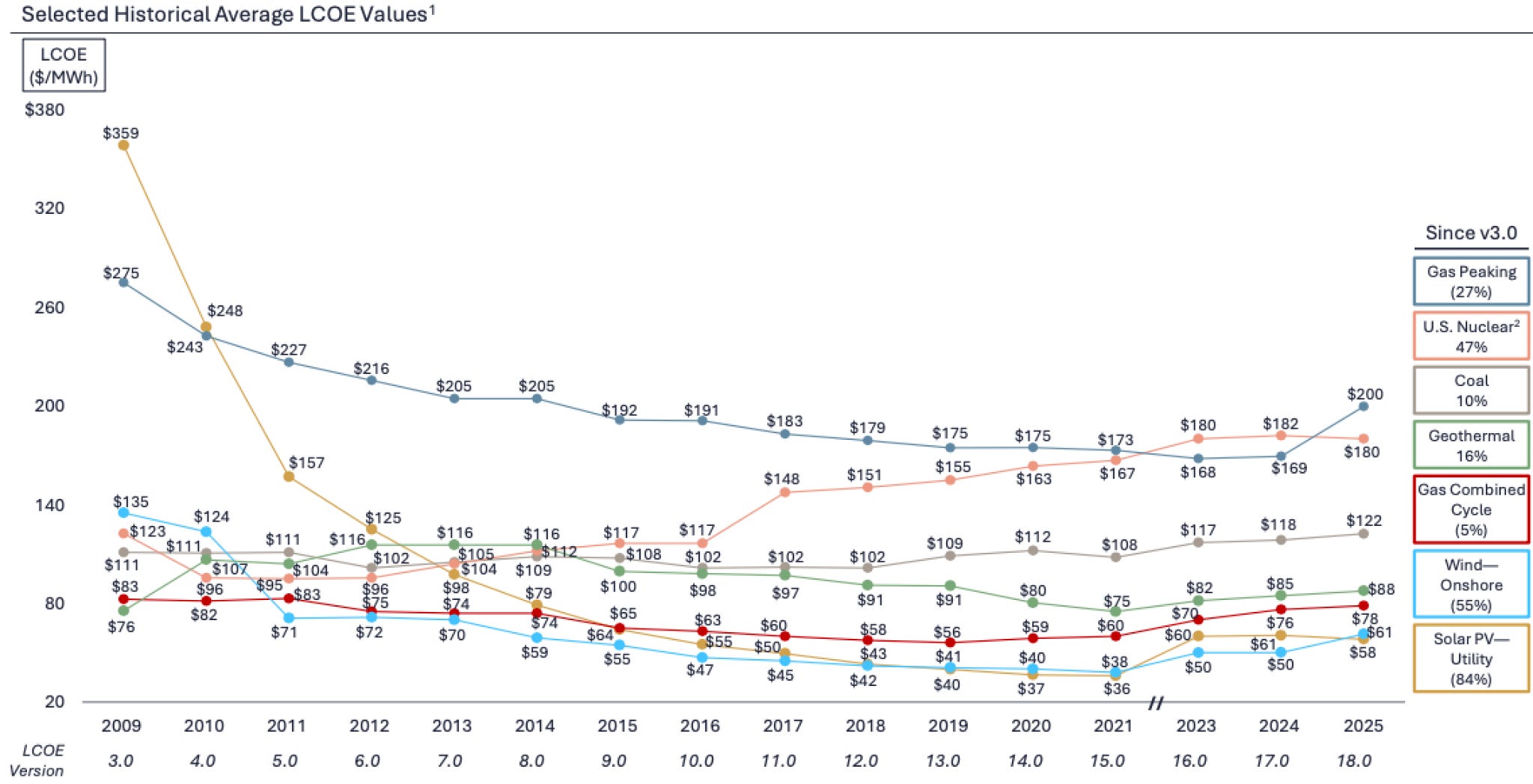
Historical LCOE values from Lazard LCOE+ 2025.
It must be noted that while LCOE captures the entire lifecycle cost of producing power, it doesn’t account for the increased grid costs of getting that power to end consumers at the right time. The notion of “wind integration cost” is widely debated and I have been unable to find a clear and widely accepted source. This sometimes only includes the cost of incremental transmission infrastructure, but may also include the cost of having standby conventional generation available for times when wind is not blowing. There are a number of strategies being used to reduce these costs, such as co-locating wind, solar, and batteries together in one site, so they can share and increase utilization of transmission infrastructure. Falling energy storage costs are an important aspect of this, which I will cover in future posts.
So far we have looked at wind power as a single category, but when you dig deeper you will find that wind power is often divided into onshore and offshore, which should be viewed quite differently. Offshore wind holds massive potential because wind speeds in oceans and seas are far stronger and more reliable than most land locations (see the above capacity factor map for visual proof). However, so far most wind development has been onshore, mainly because offshore wind faces significant technical hurdles in assembly and transmission, as well as higher maintenance costs. Globally, 93% of new wind power in 2023 was onshore, according to IEA. This is an area where there is significant R&D activity, such as floating wind turbines, and we could see dramatic adoption of offshore wind in future if newer technologies are able to lower costs. It is best to think of onshore wind as a mature technology, and offshore as a more nascent technology that will likely expand its share over time as it matures.
To sum up, wind power is a fast growing, incrementally improving, and economically viable source of power. There is a lot of nuance involved though - selecting the right location for wind projects based on both wind and energy consumption patterns is important. In countries at higher latitudes, wind will be a particularly valuable resource for power in the darker months of winter. In sunnier southern locations, it will likely play a more niche role where the lower cost and higher predictability of solar power are more competitive. In most locations the optimal energy mix will include at least some wind, together with solar, hydro, and storage. We’ll turn to looking at energy storage in more detail next week.
Resources
Some useful further reading on wind power:
IRENA introduction to wind power - A good high level overview with interactive data sets
IEA wind power page - Links to a significant amount of data on different aspects of wind power. The IEA are infamous for being conservative on their future projections for renewable power, but their historical data sets are quite good.
Global Wind Atlas - A fantastic resource for digging into aggregated historical wind data at different locations.
Windy.com - I honestly don’t know how useful this is as a research tool, but their world map with realtime wind data is mesmeric - it’s like staring into a fireplace.
Stanford Understand Energy - I found the full Stanford lecture less valuable for this topic, but their landing page is still a good overview with lots of facts and further resources.
Nice overview. John. Thanks for sharing your learnings.