
The Grid Inertia Problem
Most of the electric grid, including the parts inside our homes and businesses, operate on alternating current (AC). With AC, the voltage constantly oscillates and changes direction at a fixed frequency per second, expressed in Hertz (Hz). For example grids in North America use 60 Hz, and most of the rest of the world uses 50 Hz. To keep the grid stable, this frequency must be kept within a strict range, typically within 0.1 Hz, and rarely more than 1 Hz above or below target. Many of the electric devices attached to our grid, including electric motors, clocks, and transformers, rely on this frequency for their operation. Similarly, the grid must maintain a constant voltage over time to operate safely. Safeguard relays within the grid will shutdown grid connections if the voltage or frequency falls outside the safe operating range, in order to protect all attached devices from damage.
Traditionally, this frequency and voltage is maintained in our grid through the fact that most of our historic electric generators consist of a large spinning turbine. Whether the plant is coal, gas, hydro, or nuclear, electricity is generated through a turbine that spins at a fixed ratio of the grid’s frequency. The physical inertia of these giant spinning turbines helps to keep the frequency constant over time, as well as keeping voltage constant.
Several renewable energy sources, notably wind, solar, and batteries, do not have such an inherent mechanism to maintain frequency. Although wind turbines spin, they don’t spin at constant frequencies. Solar and batteries produce direct current (DC) which must be converted into AC through an inverter. This lack of inherent frequency stabilization with renewable power is referred to as the inertia problem. As the proportion of renewables on a grid increases, and the number of “spinning things” decreases, the risk of frequency and voltage falling outside safe thresholds increases. This can lead to cascading failures in the electric grid. For example, Spain had a major grid outage in April 2025, with one of the major factors being voltage fluctuations (ENTSO-E).
Synchronous Condensers
A simple solution for the inertia problem is actually to re-introduce large spinning objects to the electric grid, so that their inertia can be used to keep frequency and voltage constant. These devices, called synchronous condensers or synchronous compensators (syncon for short), have been used in electric grids for many decades to maintain grid stability. An electric motor is used to drive a large flywheel, which is attached to a generator producing an output current. Even if the frequency or voltage of the input current fluctuates, the large rotational mass balances out the imperfections and produces a steady output current. During normal grid operation these devices remain on standby (spinning but not outputting current), but can be activated when needed to stabilize the grid. The drawback of these devices is they cost money to build and maintain, and also incur a small loss due to the energy required to drive their electric motor (ENTSO-E).
As with HVDC cables, there is a small but growing category of synchronous condensers that replace traditional copper motor coils with high temperature superconducting (HTS) coils. This newer generation of condensers have a smaller footprint, higher voltage capacity, and faster response time than traditional condensers. While they are currently more expensive to build, costs will likely fall as adoption ramps up (Energies 2025).
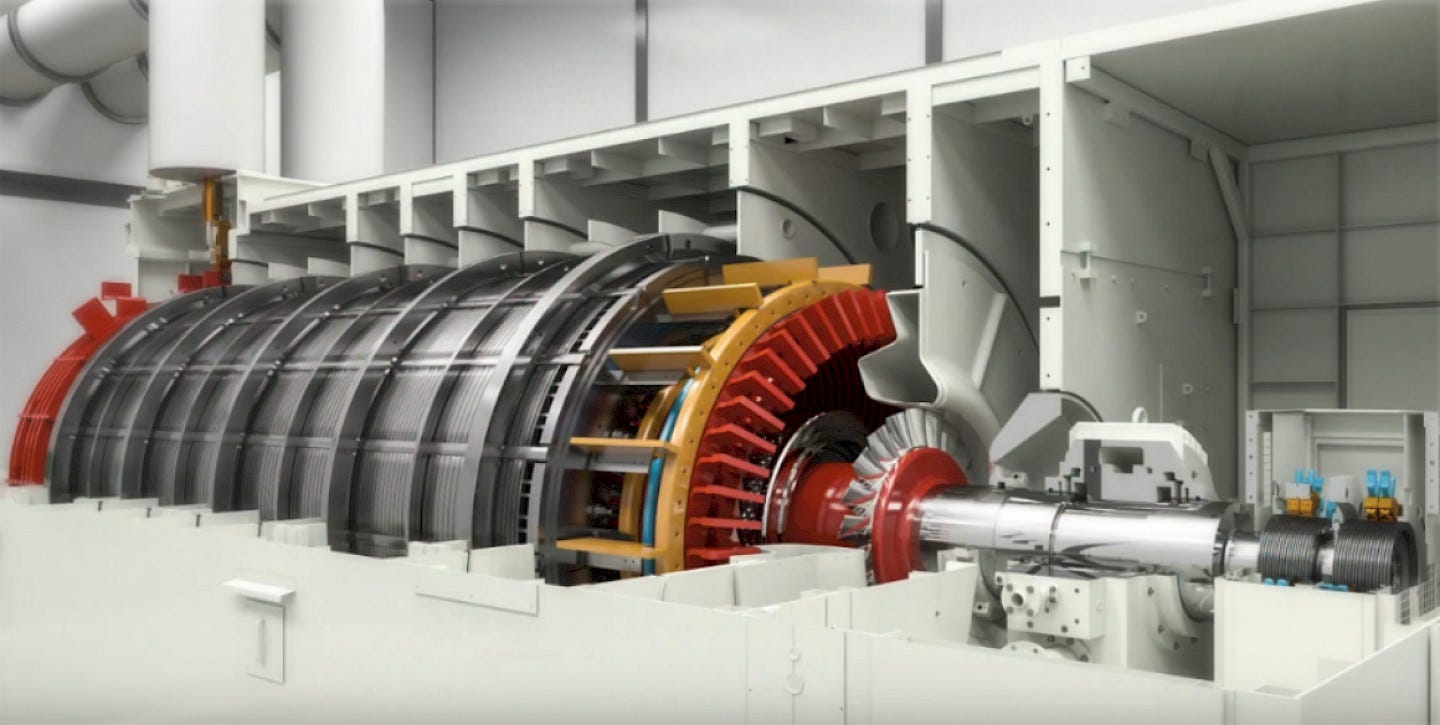
A synchronous condenser built by Siemens. Image source: Siemens Energy
Grid-forming inverters
As adoption of renewable power and battery storage ramps up, more of our grid’s AC power originates at inverters that convert DC currents to AC. Traditionally, these inverters are designed to produce an AC current that matches the frequency and voltage of the grid they are connected to. Devices designed to match the grid are referred to as grid-following devices (GFL). GFL inverters are simple, relatively cheap, and widely deployed in the grid today. However they rely on a generator elsewhere on the grid to produce the initial AC current, so they cannot be used in micro-grids composed entirely of renewable power, and can’t be used to “bootstrap” the grid after a shutdown.
In the past two decades, a new class of inverters called grid-forming (GFM) inverters has been developed. These devices use advanced electronics and software to independently produce an AC current regardless of the state of the rest of the grid. This enables them to be used to raise or lower the voltage and frequency of the surrounding grid, filling exactly the same role as traditional synchronous condensers. With the rapid scale up of battery energy storage systems (BESS), pairing a large battery plant with GFM inverters is becoming an inefficient way to provide the frequency and voltage regulation that are needed to keep grids stable. This eliminates the overhead required to maintain physical “spinning reserves” throughout the grid.
And the winner is…
With synchronous condensers and grid-forming inverters as competing technologies to solve the same problem, the obvious question is which one will win out? Grid-forming inverters seem like the obvious choice due to their lower grid overhead, assuming the inverters are already needed at large scale due to the adoption of BESS. However, as someone who spent a decade trying to make software systems operate with 99.99% reliability, the idea of a large rotating mass as a source of stability is appealing. In the end I’m not convinced that a hard either/or decision is needed here. Both solutions can co-exist on a given grid. A common market response to this problem is to invite bidders to provide these grid stability services, and then let providers compete to provide the most reliable and low cost option. Traditional utilities that are used to operating large physical plants may prefer synchronous condensers, while grids already building massive battery plants may prefer shifting to GFM inverters.
The most important point here is that when grids have high penetrations of wind, solar, or batteries, they need to make sure they are building up these frequency and voltage regulation services to take over the role previously filled by spinning generators. Failing to account for this has resulted in blackouts in Europe, North America, and Australia over the past decade, which can undermine the public’s trust in renewable power. Ultimately, the inertia problem should not be considered a barrier to renewable adoption because proven and effective technical solutions are available.
References
Inertia and the Power Grid: A Guide Without the Spin - an excellent overview of the grid inertia problem from NREL. The paper discusses how this was a particular problem from the Texas grid due to its very high level of renewable power, and how they have successfully addressed it.
ENTSO-E Synchronous Condensers - A fairly comprehensive guide to synchronous condensers from the EU transmission system operator.
Zero Podcast, Episode 144. Discussion of the Iberian blackout of 2025 and the inertia solutions that grids are adopting to prevent similar outages in future.