
Nuclear Fusion Power
Overview
It is difficult to read anything in the press about nuclear fusion without running into a whole lot of hyperbole: Scientists harness the power of an artificial sun! Tapping the energy source that powers the stars! Infinite fuel from nothing but sea water! At the other end of the spectrum you’ll find dense academic papers examining minutia such as flux mitigation actuators, or the advantages of stimulated Brillouin scattering. The claimed benefits always sound too good to be true, and the details too complex to properly grapple with. I’ve been reading and following the slow grind of progress in fusion over the past decade, so here is my attempt to capture all the high level concepts, major unknowns and risks, and its relevance (if any) to the ongoing energy transition away from fossil fuels.
The world of fusion research has been rapidly transforming in the last decade. Until about 2017, most fusion research was carried out by a small number of nationally funded research labs in countries such as UK, USA, France, Germany, Japan, and Korea. There were also a few small private fusion startups, in most cases spun out of those national labs to rapidly develop new ideas. Since then, about 30 new fusion startups have formed, raising about $9 billion USD in private funding to accelerate both research and construction of prototype reactors. Some of the best known include Commonwealth Fusion Systems ($3 billion raised), Helion ($1.5 billion raised), TAE Technologies ($1.3 billion raised), Pacific Fusion ($900 million raised), and General Fusion ($600 million raised). All these figures are from Pitchbook as of May 2026, along with a recently announced funding round from Helion. These companies have moved beyond pure physics experiments, and are focused on designing reactors that are commercially viable. A few have even optimistically entered into power contracts to sell their future output, largely to tech companies such as Microsoft and Google.
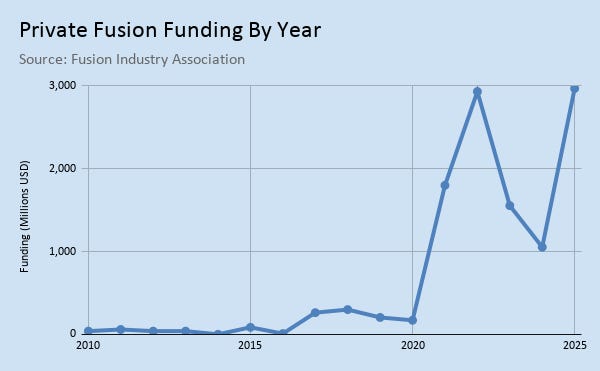
This recent acceleration of progress has led to arguments that fusion power can play a major role in the transition away from fossil fuels. As a notable example, Friedrich Merz, Chancellor of Germany, recently suggested it could replace wind power over the next 20 years (Bild). My own conclusion is that fusion research is a worthwhile investment in the long term future of energy for humanity, but it will very likely be too little and too late to be the immediate successor to fossil fuels in the energy supply. There is a significant risk that excessive hype around fusion will take away much needed funding and focus for rollout of non-fossil solutions that are ready to scale up today. I’ll come back to this in more detail towards the end of this article, but first we need to cover the basics.
How it works
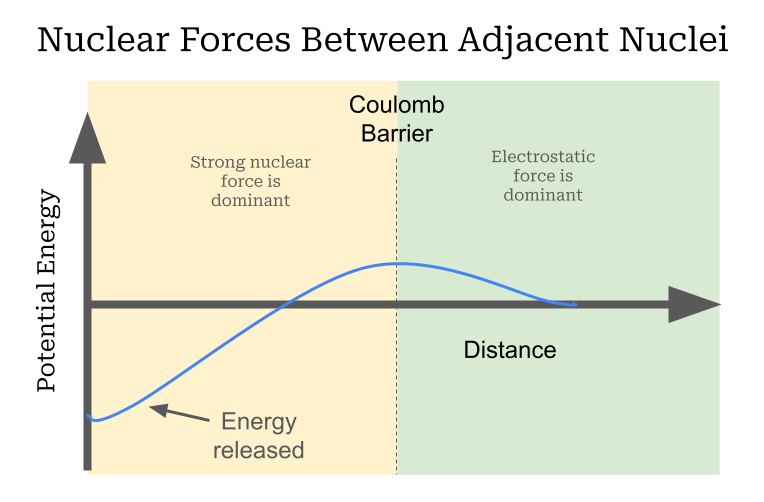
There are two fundamental forces at play on the nucleus of an atom: The strong nuclear force that holds protons and neutrons together within a single nucleus, and the electromagnetic force that pushes protons from different nuclei apart. The strong nuclear force, although more powerful, only operates over a very small distance. At sufficient temperature and density, two nuclei can be squeezed together until they overcome the electromagnetic force, and reach the threshold where the strong nuclear force comes becomes the stronger force (the Coulomb barrier). When this threshold is reached, the protons and neutrons of both nuclei combine into a single nucleus, in a reaction that releases a large amount of energy in the form of heat, light, and ejected particles. The heat can be harvested to power a steam turbine, much like any other thermal energy plant.
Fusion can become a self-sustaining reaction by heating a fuel source until it becomes a stable plasma, a super-heated gas where the electrons are stripped away from the nuclei, creating a charged 4th state of matter. When this plasma is hot and dense enough, fusion reactions within the plasma emit heat, sustaining the state required for further reactions. Crossing this self-sustaining threshold is called ignition. This state is easiest to obtain with very light gases, particularly isotopes of hydrogen, although fusion with other light elements such as helium and boron is possible. A simplified formula for the conditions required for ignition is the triple product of temperature x density x confinement time (confinement time is the duration that the plasma retains its heat). A reactor can achieve and maintain ignition by increasing any of these three variables. For example, a larger plasma increases confinement time, which is an incentive for building larger reactors. Advances in high-temperature superconducting magnets have made it viable to increase plasma density with less power draw than traditional magnets.
While there are a wide variety of experimental reactor designs, they can be broken down into two major categories: Magnetic confinement and inertial confinement. In magnetic confinement, the fuel is squeezed by powerful magnets to achieve the temperature and density required for ignition. In inertial confinement, the fuel is compressed and heated very rapidly so that it fuses before it can fly apart, confined only by its own inertia. There are also a few prototype reactor designs that combine these approaches, both bombarding and pressurizing the fuel to achieve ignition. It is worth taking a slightly deeper look at these two major categories, because the differences between them are quite significant.
Magnetic confinement is by far the most common approach, and is widely seen as the main contender for achieving a commercially viable reactor. The fuel is contained in a vessel that maintains the plasma in a specific shape surrounded by electromagnets. The most common plasma shapes are donut shaped (Tokamak), an apple core shape (Spherical Tokamak), or a twisted ribbon shape (Stellarator). These reactors are designed to maintain a plasma in a stable steady-state, which makes them ideal for a power plant looking to produce a stable supply of electricity. The development of high temperature superconductors has made it practical to maintain a very powerful magnetic force with minimal energy draw, which is one of the key reasons that fusion has re-emerged as a potentially viable energy source after decades in which very little progress was made. Major Tokamaks have been built over recent decades in the UK, Japan, France, Korea, and China. Large research Stellarators have been built in Germany, Japan, and the United States. Out of 53 fusion startups surveyed by the Fusion Industry Association, 25 are building reactors using magnetic confinement (2025 Global Fusion Industry Report).
The second major category of reactor design is inertial confinement. The best known is the National Ignition Facility (NIF) at Lawrence Livermore Lab in California. This facility uses a series of massive lasers directed at a cylindrical capsule containing a fuel pellet. The laser energy heats the capsule surface, causing it to expel the energy in the form of x-rays. These x-rays in turn heat the fuel into a plasma, sending shock waves toward the center of the capsule, where the intense heat and density ignite the fusion reaction. The NIF itself is not focused on commercial energy applications, as its purpose is largely nuclear weapons research and stockpile management (its design closely mimics the reaction inside a thermonuclear bomb). However, there are some research labs pursuing variants of this design for the commercial energy, sometimes with other input drivers such as electromagnetic pulses or charged particles rather than lasers.
While these major categories are the best known, and variants of magnetic confinement are most common, there is a long tail of other reactor designs being explored. This sheer variety is by itself a reason for optimism that at least one of these bets will pay off. Of the 50+ known fusion startups, many are exploring quite novel new designs, and most have at least a few unique elements. After many decades where three designs have dominated publicly funded labs (Tokamak, Stellarator, inertial confinement with lasers), there is more hope that design breakthroughs can fall out of the many experiments coming out of private labs. At the very least, this broad base of R&D will advance the understanding of plasma physics and advance some of the key enabling technologies such as superconductors.
The fuel for a fusion reactor can in theory be any element, but since the main barrier to fusion is the repulsion between protons, it is exponentially more difficult when more protons are involved. Nearly all reactor designs today use isotopes of hydrogen as their fuel. Specifically, deuterium which is hydrogen with one proton and one neutron, and tritium, which is one proton with two neutrons. The most common combination is a D-T reaction, where one deuterium nucleus fuses with one tritium nucleus. This particular fuel combination has the lowest required temperature to achieve a fusion reaction. Deuterium is stable and relatively abundant in earth’s water, but tritium is highly unstable and must be produced through other reactions. The general theory is that fusion reactors will “breed” their own tritium by lining the reactor vessel with a blanket of lithium. Neutrons that are by-products of the D-T reaction will strike the lithium nuclei, causing a reaction that produces tritium and helium. Therefore for practical purposes, the input fuel for a working fusion reactor would be deuterium (extracted from water) and lithium. Since a fusion reaction produces a vast amount of heat energy, the volume of input fuel for fusion is far smaller than for any conventional source fuel. By mass, fusion fuel is 4x more energy dense than enriched uranium, and 10,000,000 times more energy-dense than coal. A little bit of fuel will go a long way.
Unlike nuclear fission, the nuclear fusion reaction is very safe. Maintaining a stable plasma requires both the constant application of an external confinement force, and a constant source of new fuel. This makes a fusion reaction very easy to stop, and a loss of power to the plant would automatically stop it. Fission has the opposite characteristic since it is a chain reaction that, without intervention, will continue to react until radioactive material is exhausted. Another major safety advantage with fusion is the lack of long-term nuclear waste. The walls of a fusion reactor can become slightly radioactive, but with a much shorter half-life in the range of a few seconds up to at most 100 years. When a reactor wall is replaced, the old materials can be stored on-site until they become safe to dispose of. This contrasts with fission waste, which can take 10,000 years or more to decay to a safe state. Finally, unlike nuclear fission, the fuel and other materials involved in nuclear fusion are not directly transferrable to nuclear weapons. While thermonuclear bombs may use tritium as part of their secondary fusion reaction, they cannot operate without highly enriched uranium or plutonium.
Current state of progress
A success metric that many experimental fusion projects focus on is net energy gain, also called the Q-factor. Q is simply the heat energy produced by the plasma divided by the input energy required to maintain that plasma. A value of Q>1 indicates that there is more energy produced than consumed (referred to as the scientific break-even point). Note that in most cases the desired output is electricity rather than heat, and this does not account for the energy loss from converting heat into electricity via a steam turbine. A value of Q>=10 is therefore required to obtain a practical energy gain. The Q-factor also doesn’t account for energy losses on the input side, since it measures only the input energy to the reaction itself. For example, an inertial confinement reactor using lasers that are typically only 1% efficient, needs a Q of 100 or more to account for the energy loss of the laser. In theory, once a reactor reaches ignition and becomes self-sustaining, then Q becomes infinite.
At time of this writing, the only reactor to achieve a value of Q>1 is the National Ignition Facility (NIF) reactor in the US, which achieved a value of Q=4.1 in April 2025. As previously mentioned, this result deserves a large asterisk because they measure gain only at the target, ignoring the 99% power loss from the lasers. The best recorded result for a Tokamak reactor, the most likely design to achieve commercial scale, was a value of Q=0.67 by the JET reactor in 1997. The ITER reactor being built by a global consortium in France is designed to have a value of Q>=10. It should be noted that all operating reactors produced so far have been focused on scientific experiments rather than net energy gain. The goal for most reactors is to further understanding of plasma behaviour and other aspects of reactor design, so judging them by their Q value misses the point of why they were built.
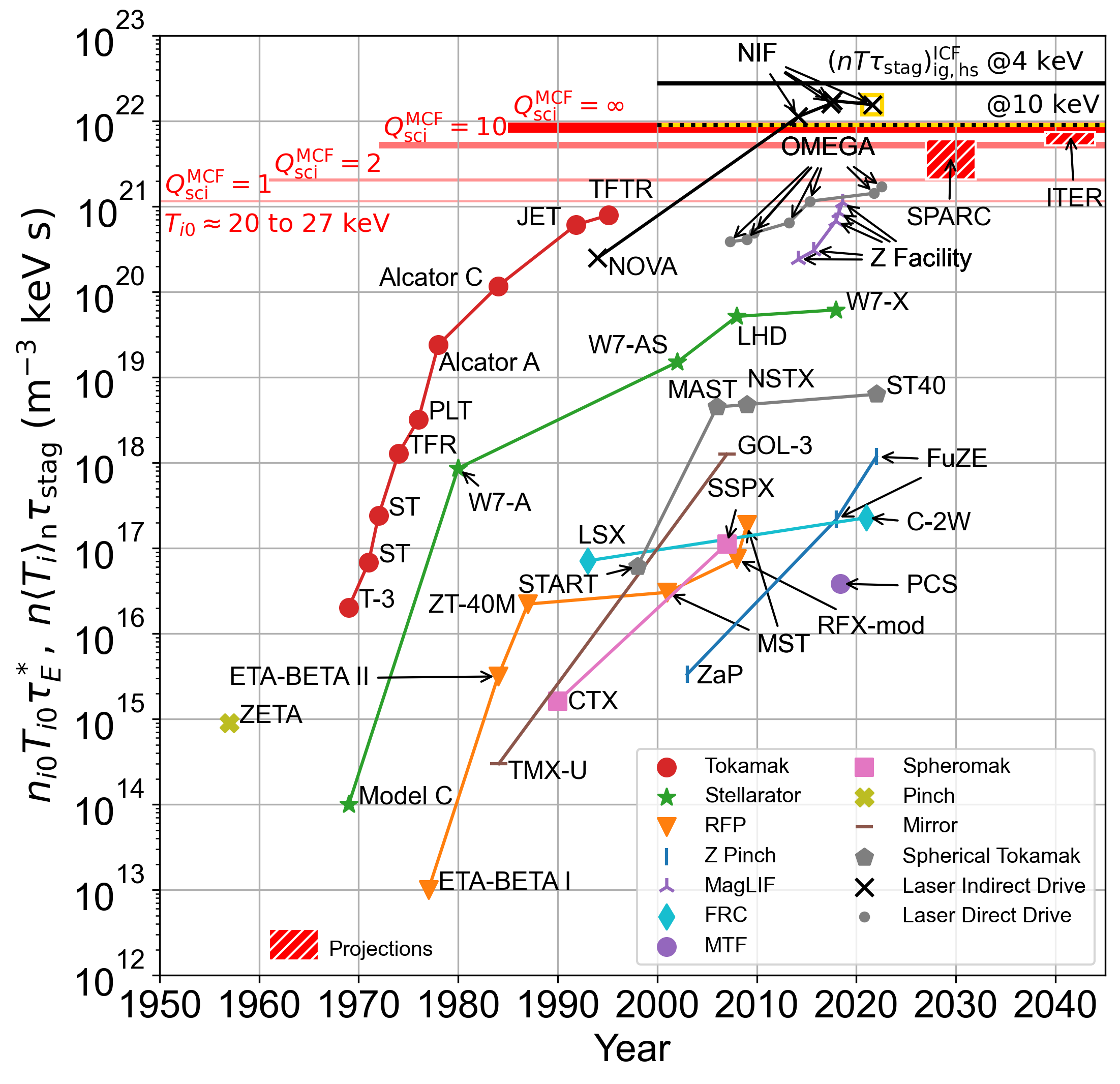
Experimental fusion reactors by year and Q factor. Source: Wurzel and Hsu, 2025.
It is worth emphasizing that net energy gain is an incredibly low bar by which to judge a practical energy source. By this metric, solar power demonstrated net energy gain in 1883, when Charles Fritts built the first solid-state solar cell (assuming sunlight is a free input). A much more important milestone will be a working reactor that is commercially viable, taking into account all the costs associated with constructing and maintaining the plant. This, by all accounts, is some ways off. The Fusion Industry Association, an industry trade group that you would expect to be on the optimistic side, surveyed their own member companies on this and other topics in 2025. When asked, “When will the first fusion plant demonstrate a low enough cost/high enough efficiency (Q) to be considered commercially viable?”, 66% believed this will come in 2036 or later, and 34% believed it won’t arrive until 2041 or later (2025 Global Fusion Industry Report). It is likely the first generation of commercial reactors will have construction timelines comparable or worse than fission plants, which on average take about a decade to build (World Nuclear Association). All this means it is likely that fusion power will, at best, provide a tiny fraction of energy grid power before 2050.
Risks
A major existential risk for fusion power is that it will turn out to be far more expensive as an energy source than the alternatives that are already available at massive scale. While many fusion startups claim their designs will be cost-competitive, we just won’t know what their true levelized cost of energy (LCOE) will be until a commercial-scale demonstration reactor is built. We are now in a world where intermittent renewable power is very cheap, and energy storage options are also improving, reducing the value of expensive large-scale plants.
A second concern for fusion reactors is that they will face the same major-project risks faced by current large-scale fission and hydro plants. Magnetic confinement reactors in particular have a technical pressure to be built on a large scale, since increased plasma volume directly raises the achievable confinement time, making ignition easier. Such large-scale projects are typically plagued by extended construction timelines, cost spirals, and the resulting high cost of capital - and that’s even when building centuries-old technologies such as dams. The world’s largest fusion reactor under construction, ITER, is a case in point. Construction on ITER started in 2013, but it is not expected to be fully operational until about 2035. Its original budget of around €6 billion is now expected to be nearer to €20 billion. While costs and timelines can come down with wide deployment, this could take several decades and is far from certain.
Finally, while the core concept of fusion reactions is well developed, there are significant unsolved problems relating to fuel and waste. As previously mentioned, tritium is unstable and must be created synthetically in a process known as breeding. The basic breeding reaction is known to work, but no reactor has yet demonstrated a breeding process that can reliably produce more tritium than the input fuel used in the initial reaction. A related problem is that the high-energy neutrons required for breeding also react with the walls of the reaction chamber, making them mildly radioactive. This introduces radioactive waste, and although the half-life involved is far lower than with fission waste, it complicates the operating lifecycle of potential reactors. There are potential alternative fuels that emit far fewer stray neutrons, known as aneutronic fuels. Leading examples combine simple hydrogen with boron (p-B fuel), or deuterium combined with He-3 (D-³He fuel). While p-B has a much simpler supply chain and aneutronic fuels produce less waste, they also require a much higher triple product to achieve ignition. In short, all the known fuel options have significant risks attached.
Role in the energy transition
A major argument for fusion in the past is that they could provide “always on” power, swapping into the exact role played today by “baseload” plants such as coal, combined-cycle gas, and nuclear fission plants. This makes the idea more attractive than intermittent renewables, especially for traditional grid planners used to working with this kind of generation profile. However, the dramatically falling costs of intermittent solar and wind have completely changed the economics of power markets. Since these sources have near-zero marginal costs, they will always be dispatched onto the grid first. What the grid really needs now is not “always on” power, but rather dispatchable power than can fill in the margins on very hot or cold days, or when weather conditions won’t cooperate. The economic case for baseload power is eroding, and storage solutions will likely end up being far more economic than large-scale redundant power sources for those few peak hours when they are needed.
Furthermore, as discussed in the section on risks, fusion power will likely arrive much too late to have an impact on the timescales required to mitigate the effects of climate change. While we may see the first commercially viable reactors in the next 10-15 years, it will likely take 2-3 generations of reactors before they are fully proven and ready to scale up. Money and research energy being directed towards fusion could have a larger climate impact if applied to scaling deployment of cheaper alternatives, or to other decarbonization technologies (green steel, aluminum, fertilizers). A possible role for fusion in the future is to act as a successor to nuclear fission once economically viable uranium is depleted, but this problem is many decades away.
In the end, I’m glad we live in a world that is willing to place bets on technologies that will likely serve humanity in the long term future. I hope that the current surge of startup investment will yield breakthroughs in reactor design and fuel lifecycles that make fusion a viable energy source for future generations. Some day, humanity may indeed reach a stage where it requires a further 10-100x energy in a world where all the traditional fuels are tapped out; or we may unlock interstellar travel, for which fusion power is a leading candidate. Even in the short term, the fusion-driven research investment in superconductors in particular will very likely be transferrable to other power systems such as HVDC lines and transformers. However, unfortunately it would be a tremendous risk to bet on fusion playing any significant role in the energy transition over the next couple of decades. Most planning and investment should be focused on deploying and scaling known solutions such as solar, wind, batteries, and hydro power. A more appropriate place for speculative investment would be geothermal power, since it would provide the same “always on” generation curve as fusion but requires much smaller technical breakthroughs to achieve commercial scale.
Resources
The Future of Fusion Energy, by Justin Ball and Jason Parisi - This book is a solid introduction to nuclear fusion and is readable for a mildly technical audience. It lays out the case for fusion, with a detailed response to all of the arguments against it.
The Global Fusion Industry in 2025, Fusion Industry Association. You need to signup for their newsletter to download it, but you can immediately unsubscribe. This report provides a detailed look at the state of commercial fusion, including snapshots of each company and results from their annual member survey. Although obviously biased in favour of fusion, it’s a useful annual read to catch up the latest developments.
Fusion Overview, Stanford Understanding Energy. The usual thorough and trustworthy overview from Stanford, along with a free short overview video and extended lecture.
Thanks for another great overview, John!