
Coal Power
It is hard to fully understand the dynamics of the energy transition without taking a closer look at the energy sources we are moving away from. The politics, geology, and market dynamics around these legacy fuels, along with their existing structural supports and subsidies, influence how quickly countries move away from them. In the world of electricity, there is no bigger target to look at than king coal.
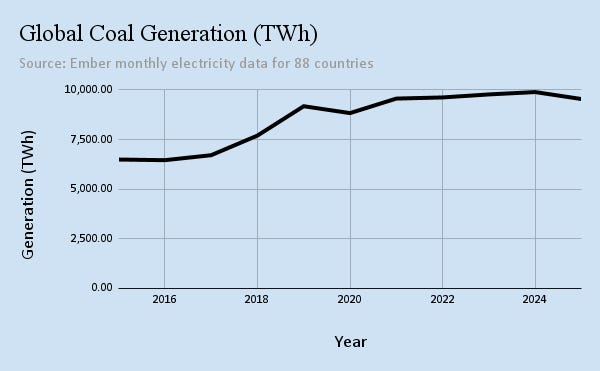
Coal has been the dominant global source of power for electricity generation since the age of electricity began. It remains the biggest single fuel type even today, generating roughly 10,500 TWh of electricity per year, with a 34.1% global share as of 2024 . Over half of total coal generation is in China (5,830 TWh/year), with India (1,520 TWh/year), and USA (650 TWh/year) being the other two top producers (all data from Ember). While coal’s share of electricity production has been in decline since 2013, the total TWh generated has continued rising in most years.
However, when using the latest monthly electricity data from Ember, which covers 88 of the top energy consuming countries, it appears that we may have finally passed peak coal in 2025. Although a few countries have not yet reported data for December 2025, we may end up with a small decline in coal generation for the year.
Coal as a fuel
Coal is even less renewable than other fossil fuels. Most of the world’s coal was formed during the Carboniferous Era (~360-300 Ma) from trees. After this period, fungi and bacteria evolved to break down tree wood into other forms. Since then, coal only forms in isolated areas free from these life forms, such as in bogs. However, there are still vast reserves of coal available today, and they are widely distributed around the world. As with other fossil fuels, coal gets incrementally more expensive to extract over time, as miners exhaust shallower sources before moving onto deeper ones. Typical mines are found at depths below 1000m today, whereas 20 years ago the average mine had a depth around 600m (source).
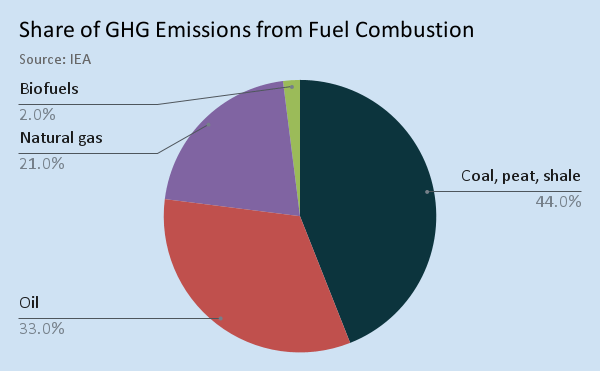
Burning coal emits more greenhouse gases than any other major fuel source, accounting for 44% of global energy-related GHG emissions (IEA). Coal plants emit roughly 900 gCO2/kWh, compared to roughly 400 gCO2/kWh for the cleanest gas plants (IPCC, p. 295). Apart from the climate warming impact, burning coal emits fine particulate matter (PM2.5) with significant quantities of sulphur, lead, carbon, and other metals. Excess deaths near coal plants show that each plant kills thousands of people prematurely (NIH), making it by far the most dangerous large-scale power source. Depending on the variety of coal, coal power plants cause between 25-32 excess deaths per TWh of electricity generated (Our World in Data).
Coal power is around the middle of the pack on cost per unit of electricity. It is generally more expensive than solar, onshore wind, and combined-cycle gas, but cheaper than nuclear and gas peaking plants. Since roughly half the cost of coal power is from the fuel, this varies based on the price of coal, which fluctuates quite a lot (Lazard).
Technology
The technology involved in coal power generation is fairly simple, and has changed little over the past century. Coal is burned to produce steam, which runs through a steam turbine to generate electricity. In a typical plant, this process is about 33% efficient, meaning 67% of the coal energy turns into waste heat. This efficiency has been slowly increasing over time in new plants, but there are tradeoffs involved. For example, burning coal with higher carbon content is more efficient, but more expensive to produce.
As with other power plants, a plant’s capacity factor is the ratio of actual output to theoretical peak output. Coal plants traditionally had capacity factors in the 70-80% range, as they filled the role of “base load” that was generated all day and night. In the past decade, the role of coal plants has shifted, since they cannot compete on cost with renewable resources like wind and solar. They are now more often employed as load-following or peaker plants that only produce power during lulls in renewable production. In 2024, coal plants had an average capacity factor of 42% in the US, and 56% in China. When looking at coal plant data, it is more useful to track actual output than capacity, since it reflects this changing role for coal plants. Particularly in China, these stats show a divergent trend, where capacity continues to increase while actual production is starting to decline.
A key metric for peaker plants is their ramp rate, which measures what proportion of total capacity can be brought online per minute. This is critical for plants designed to follow the load and ramp up production to meet rising demand. Coal plants have quite a poor ramp rate, generally around 4% per minute, since they need to heat very large furnaces to begin power production. Single cycle gas plants are more effective at ramping due to their much higher burning temperature, and can ramp up at a rate of 20% or more per minute.
A newer generation of coal plant, Integrated Gasification Combined Cycle (IGCC), promised to abate many of the negative effects of coal power. In this system, the goal is first converted to a gas, and then runs through burning and heat recovery cycles like with a combined-cycle gas plant. This system can scrub many of the harmful pollutants from the coal prior to burning, and the gasification produces a stream of pure carbon that is much easier to capture and store. However, despite two decades of feasibility studies and demonstration plants in the US, Canada, and China, the technology failed to gain traction due to system complexity and cost. It proved far more efficient to move to either renewable power or gas power plants than invest in cleaner coal plants.
Phasing out coal power
Coal power has proven remarkably difficult to phase out, despite significant environmental harms and the availability of cheaper clean alternatives. This resilience has been driven by large increases in coal power production in Asia, particularly China and India. The abundance and reliability of coal has made it very attractive in countries that would otherwise be dependent on fuel imports. Large sunk infrastructure costs also make the phase out happen very slowly. Most of the coal plants in Asia are under 20 years old, which means they have decades of operating life left before they need replacing. The most likely trend in the coming decades is that construction of coal plants stops, and then over 20-30 years they will be slowly phased out as they reach end of life. As previously mentioned, plants will also be run less often, filling in the gaps in the energy supply only as needed.
65 countries have signed up to the Powering Past Coal Alliance (PPCA), which aims to accelerate the phase out of coal through incentives and other transition support for countries dependent on coal power. 28 of those countries have already phased out coal power, and several other major countries aim to complete their phase out by 2030 (including Canada, UK, USA, Italy, and France. China, by far the largest producer, has not yet committed to phasing it out, but their rapid adoption of renewable power is enabling them to begin that phase out soon.
Resources
IEA Coal Landing Page - Very detailed overview of the coal industry
Stanford Understand Energy - As usual, Stanford has a good detailed overview page 10 minute and 1 hour free lectures, and links to further resources
Thanks for another great breakdown, John.